Tuesday, July 31, 2012

Adding Dimension to Your Cloth

Many artists working on a flat surface continually strive to create the illusion of depth and texture. There are many printing and dyeing techniques that accomplish that goal.  However sometimes the work calls for an element that is raised above the surface of the cloth. Do you want to create real texture, not just the illusion? Over the next few weeks I'll highlight some of the techniques I use to add dimension.

Hand stitching in a contrasting or complimentary color adds a nice accent. If you don't consider yourself good with a needle - no problem. I did not come from a stitching background. When I first started using stitch seven years ago, it felt very awkward. But I have come to love it. I find it calming to sit with a needle and thread. You don't need to know any fancy stitches - a simple stitch repeated many times can result in a rich surface. 

Use a thicker thread (4-6 strands of embroidery floss or size #3 or 5 of pearl cotton)  for more impact. Embroidery floss is made up of six strands that can be separated to create the desired thickness. While that sounds great because you have the flexibility to create the thickness you want, beginners may find it harder to stitch with the floss.  Sometimes the plies separate while stitching, leaving a loose thread in some stitches. Pearl cotton has multiple plies, but they are non-divisible. It comes in several thicknesses - the smaller the number the thicker the thread.

This Moment, detail view

This Moment, detail view

This Moment, 80" x 24", Silk noil

 See how a simple straight stitch in red thread draws the eye into the small circle?

Marking Time, detail view

Marking Time, 80" x 24", Silk noil

The stitching on Marking Time is more subtle.  A tone-on-tone effect was used to keep the emphasis on the red painted marks.

The decision about what stitch to use was easy.  These two pieces explore our emphasis on "marking time" - looking to the past or future rather than focusing on the current moment. The universal symbol for counting seemed to make sense as a stitched element.  As did a double chain stitch to complete the larger circles on This Moment.

Tuesday, July 24, 2012

Three Dimensional Fiber Art DVD released

Yeterday my new DVD, Three Dimensional Fiber Art: Shape and Texture, Light and Shadow was released. It is very exciitng to be an "author", especially after all the years I spent in educational publishing!

Here are links to the various versions of the DVD.

*Digital download available now! It’s available in both HD ($16.95) and standard ($14.95):


HD download link: http://www.interweavestore.com/Quilting/DVDs-Videos/Three-Dimensional-Fiber-Art-Download-in-HD.html


Standard video download link: http://www.interweavestore.com/Quilting/DVDs-Videos/Three-Dimensional-Fiber-Art-Download.html


*DVD available: 8/21/12 - $19.95. It’s available now as a pre-order:

http://www.interweavestore.com/Quilting/DVDs-Videos/Three-Dimensional-Fiber-Art-DVD.html

Interweave has been a great company ot work with on this. The experience was enjoyable and I learned a lot in the process.


Tuesday, July 10, 2012

Ice Dyeing


I'm a little late on the ice dyeing craze, but I finally made time to try it.  I read about snow dyeing several years ago and thought it sounded interesting, although not very practical for someone who lives in a warm climate.  Ice dyeing makes more sense, and summer is actually a good time, because the mess can stay outside.


After doing an internet search, I realize there are many variations. I chose to work with the dyes in their powdered state rather than mixing them into a liquid.  I placed a tarp on the ground outside and used a plastic grid from a commercial light fixture to raise the fabric out of the melting ice/dye.

I am pleased with the results, although I have to admit that while it was in process I was not impressed.  I had read some comments that the results are similar to what you get with low water immersion dyeing.  I found a significant difference.  The patterning is hard to describe, but it has a distinctive look. Here are my results (I used Dharma Bronze and ProChem Tobacco on all these pieces):


This is a piece of silk dobby noil (from Thai Silks). It is a wonderful fabric and it took the ice dyeing beautifully.


This is a heavy-weight cotton. 


This is silk habotai, and it was underneath the two previous fabrics to catch the dye as it dripped down. This looks like a typical low water immersion dye.


This is also cotton, and it was dry when I placed the ice cubes on top.  The other fabrics were all wet.


This piece was underneath the plastic grid to catch the drips from the previous cloth.


Have you tried ice and snow dyeing?  What was your experience?

Thursday, June 28, 2012

Studio space

Here are some photos of my soon to be organized new studio space, I can't even figure out how I had all this stuff crammed into my 2 rooms at home. I feel like it was the clown car where people keep getting out of it! I am looking forward to getting a workshop line-up going in the fall because I can now have 10 or so students at a time. And it ahs been fun to be in a space with other artists again. Lots of ideas are generating!


Friday, June 1, 2012

EVER TRIED VAT DYE DISCHARGE?!

I've been incorporating vat dye discharge into much of my fiber work.  It is a serendipitous way to create new markings and color with rich warm hues on previously dyed fabric by using bound resist techniques such as Shibori.  In addition, an amazing and magical phenomenon happens around the resisted area called "halo effect".


Besides vat dyes, 2 chemicals: sodium hydroxide (lye) and thiourea dioxide or sodium hydrosulfite must be added to the dye bath to accomplish the discharge and color replacement.  After dyeing, the fabric must be exposed to the air to oxidize.  It's all worth it since the results can be breath-taking and fill your soul!  Imagine removing color and adding entirely new color in selected areas simultaneously!!!


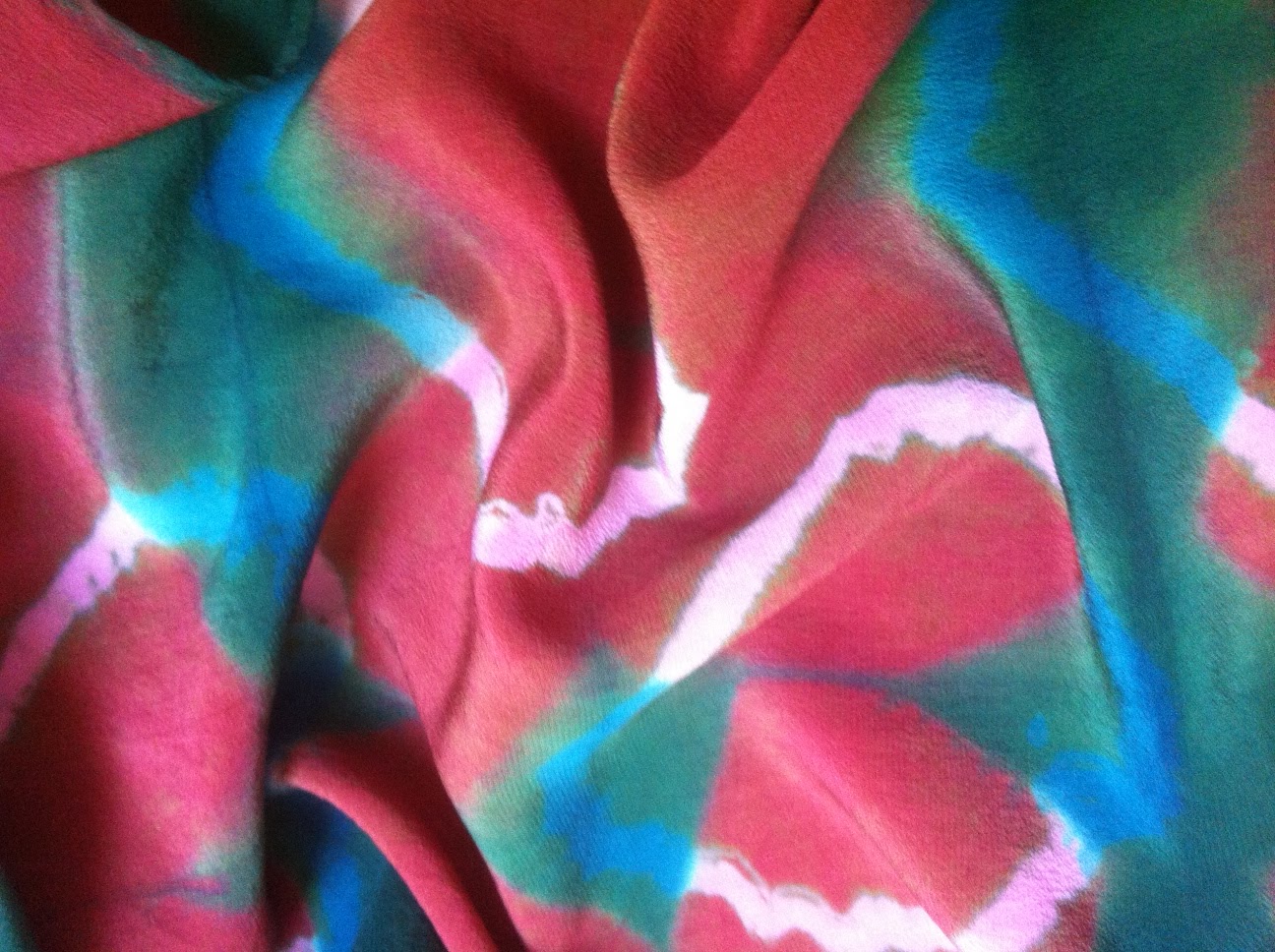
This Spring I put together a new collection of scarves with shibori using vat dye discharge in "to-dye-for" colors in luscious jade, apple, turquoise, orange and shocking pink. I used rubber bands, folded and clamped wooden blocks and braiding for resist.  Some examples of my creative process follow. The first 2 images portray the "braided" method on silk charmeuse.


 This scarf was first ground dyed with shades of raspberry and bronze and then vat dye discharged with turquoise - eye candy!
This multi-colored "cold-water" immersion dyed silk scarf was vat dye discharged with jade.
What lovely patterns, color and texture can be achieved using these methods!

Next, I vat dye discharged with apple green using the "fold and clamp wooden block method following a multi-colored dye process with cold water immersion dye!


 This charmeuse scarf was first dyed pale pink, band resisted and vat dye discharged in shocking pink and lastly fold-clamp method with jade.  Notice the "halo effect" around the light pink circles - it's amazing!


This last example was dyed pale blue on silk crepe, banded and vat dye discharged with apple green, then "braided" and vat dye discharged in orange...


I buy vat dye products from both Pro Chemical and Dye in Somerset, MA (1-800-2-BUY-DYE)(www.prochemical.com )  and Aljo Mfg. Co. in New York, NY ( 212 966 4046).


Are you ready to try Vat Dye Discharge??? Just imagine the limitless possibilities!!! 


Any questions, you can contact me - Mary-Ellen Latino (melsrun2000@gmail.com) or the manufacturers...


Reach for the moon and catch many amazing stars along the journey!

Wednesday, May 23, 2012

CAN YOU FEEL THE RHYTHM?


 I am interested in translating movement to cloth.  I take my inspiration from music and dance.  This is a very broad subject so I needed to narrow my focus.   My brush idea sprang to life while watching a Dale Chihuly  video.  He stands over his large paper and uses household brooms to apply his paint.  What a wonderful way to apply movement and physical action to my artwork.  I began using various brush marks that I make while listening to different types of music.  I use commercial, found and hand crafted brushes.  A few of them are shown above.


Here, you can see an example of these marks.  In this piece, Continuum I, I was listening to the Bach Suites for cello.  I placed the brush marks directly on the hand dyed fabric using black textile ink and a small wisk broom.


Another one of my favorite tools is soy wax, brushed on a 24" x 30" silk screen and also directly on the fabric.


                         The results after multiple layers of dye printing.


In my most recent work, I am exploring layering.  One set of brush marks, made on one piece of fabric, inspired by one piece of music, and another set of brush marks, inspired by a different piece of music printed on a sheer fabric.  This gives me the ability to combine multiple layers of brush marks and music.  Like the notes on a music score, the possible combinations are endless.  What is your creative rhythm and how do you get there?

Wednesday, April 18, 2012

MY CREATIVE PROCESS


I make Anti-War Art. I am passionate about this pursuit.


Believe it or not, I’ve had a delightful past three weeks, starting two days after surgery to have my hip replaced. Sound strange? Perhaps. But I’ve had all this time to myself at the hospital, at the rehabilitation center, and now at home with all kinds of precautions keeping me from doing “housey” and other things which normally seem to take up so much time. And I can’t drive for another couple weeks.


So, I am voraciously reading many of those WAR books that have been waiting and making extensive notes about ideas I want to consider. I am doing research online and making sketches and trying new techniques and processes for my next ANTI-WAR ART pieces which sit in-waiting. It’s wonderful. It’s luxurious. I have nothing to do but focus on my art and the visits from my physical therapist.


In developing my ANTI-WAR WORK, I use processes and materials designed to generate discomfort, sadness, disgust, and shock on the part of the viewer. I intentionally use discordant colors. I use beautiful colors to create an awkward juxtaposition with a deadly weapon or other horrific war image.


Let me talk about my process for making a recently completed piece called Letters Home to Mom . I started by talking to some veterans at a local meeting of Iraq Veterans Against the War. A few meetings later, I had an opportunity to ask them what kinds of things they wrote home to their mothers about when they were away at war. I used many of these thoughts along with several ideas garnered from the many war books I read and began composing more than 25 of these ideas into letters.


Next, I began thinking about what other imagery I might want in this piece. And I remembered one soldier telling me how much his mother liked to knit. I then imaged the many ways mothers spend their time while their children are fighting at war. And the vision of mothers sitting in a circle knitting items of clothing for their soldier children came to view. This led to my beginning to knit more than 40 white patches using different types of yarn and different stitches. And this led to my needlefelting these patches together into a “beautiful” crazy quilt in the form of an AK47 gun embellished with lavendar shiny yarn. To complete my imagery, I developed some other AK47 guns using black dyed organza.


So I then had about 25 letters painted with white paint on dyed pastel organza pieces, a large knitted AK47 gun and some other black organza AK47 guns. What to use for a background? At that point, I quite accidentally spilled some india ink on white fabric. My daughter thought it looked like splotches of blood. My grandson thought it looked like shrapnel falling from an exploded IED. And it reminded me of one of my grandmother’s dresses (the grandmother who knitted a lot.) That was it. I developed a large 50” x 74” piece of white fabric by painting india ink splotches on it. And finished the piece.


Which brings me back to Creative Process. How does it happen? On the one hand, it feels easy when you are in the flow. On the other hand, it can feel really tough and challenging and hard to keep pressing on. Or it might feel as if I just learn enough new techniques and theory, it will just happen. But in the end, for me, it requires digging down deep into the painful part of a lifetime of experience and developed awareness. It’s complicated.


What is your creative process?


Tuesday, April 17, 2012

What is Your Approach to Creating?

I have two ways of approaching the creative process.  Sometimes I have a vision for a series of pieces. I have a message I want to communicate (or more often, it's a feeling I wish to convey). I work deliberately to create that vision.  This often means that I do samples to test colors and even create a mini-version of the composition. This tends to be a slow process and sometimes I get bogged down in the detail.

The other way in which I work is to do what I call "intentional play".  I'm playing, in the sense that I have no pre-conceived vision or expectations for the cloth. I take it one step at a time and let the cloth "speak to me" to build each layer.  It is intentional in that I choose a surface design technique, a certain approach to color or a compositional style and focus on that as I work on the piece. The spontaneity is a nice complement to the more planned approach. 

What is your approach?  The first, the second, or something completely different?

Tuesday, April 10, 2012

Text on Textiles


I've recently been teaching my first on-line course through Joggles, and thanks to Barbara's easy instructions, its been a seamless and enjoyable experiment -- though I would have liked a bit more feedback from the troops. But, I can just send it out there and hope that the info is landing well!

The photos above show a few surface design techniques, and prints on fabric, that put text on textiles. This summer I'll be teaching another 4-week on-line class with additional techniques and ideas for how to incorporate text into textile design.

Monday, April 2, 2012

Lines and Numbers exhibit and Fiber Philadelphia

Hi everyone,

Several members have just returned from a great weekend at Fiber Philadelphia 2012. We had a very positive response to our Lines and Numbers exhibit and lots of people came to the reception. The space was terrific and every piece was shown well and with space around it to really see it. One of the people who has already followed up with me after the weekend was Vivika Hansen DeNegre who is the Editor for Quilting Arts magazine. She was very impressed by our exhibit and wanted to know even more about art cloth. This is the same magazine that just had the article about our group! So we are making an impact on people out there in the world!

Judy and Brian Langille and Dianne Hricko did a great job  hanging the exhibit and getting things ready for the reception and it is much appreciated.

Russ, Mary Ellen, Judy, Joy, Connie, Barbara and Lisa were at the reception so we were each able to spend time with viewers and explain about different techniques.

Here are a few photos from the reception. I also sent these as an email to everyone so one way or the other you should be able to see something


.