Showing posts with label Art Cloth Network. Show all posts

Sunday, September 22, 2024

Marbling Fun with Friends - by Regina Marzlin


 I belong to a textile art group in our province of Nova Scotia, Canada. We call ourselves “Textile Artists Collective of Nova Scotia” and we have been meeting once a month (with the exclusion of the summer months) for about 12 years now. It is a great group of a dozen friends and fellow fiber artists that has been a wonderful source of inspiration and feedback for me. I have to drive a 260 km /160 miles roundtrip to get to our central meeting location but it is worth it.

Our group has been exhibiting a couple of times over the last few years. In 2023 we had a show concurrent to the Quilt Canada convention in Halifax that was quite successful. Now we are preparing for a show in a gallery in Lunenburg on the South Shore of Nova Scotia in November.

At our monthly meetings, we strive to often do a hands-on activity, a small workshop or demo, to introduce our members to new techniques and to have fun playing with new materials.

 At our last meeting, one member had prepared a demo on marbling on fabric. She provided the materials and we could then try it out for ourselves.

The technique for marbling fabric is not different from marbling paper, an ancient technique to print colorful and elegant papers. These papers were often used in bookbinding.

We set up trays with thickened water. The thickening agent can be Carrageenan (a non-toxic thickener made from seaweed), or methyl cellulose (aka wallpaper glue). The fabric was mordanted with alum so the paint would adhere to it better. There are multiple options for marbling paint, like inks and liquid fabric paints. We used a commercial line, DecoArt Water Marbling Acrylic Paint, which had a good range of colors and comes in handy little drop bottles, which are easy to use.


The paint gets dropped onto the surface of the thickened water and starts to expand and contract and swirl around. We continued filling the surface with paint until it was to our liking. Then the piece of fabric is placed on top and immediately soaks up the paint that floated on the surface. The process was not very controllable as our water mixture was a bit too liquid, so we could not really make pretty patterns with combs or sticks as they disappeared almost as soon as we made them. Nevertheless, we had some neat results and enjoyed trying a fast and easy way to get color onto the white cloth.


Here I am working on dropping the paint onto the surface, and the resulting cloth is below.


Here is another fun print:


Some of the paint had dropped to the bottom of the pan and we used this leftover paint for some “mop-up” prints that can also be quite interesting. 


After drying, the paint needs to be heat set so the fabric is ready to use.

I can definitely recommend this quick and fun activity if you would like to try it!


Photo credit: Fiona Oxford

Saturday, July 13, 2024

Renewal: Inside a National Fibre Art Exhibition by Sue Sherman

This past Sunday, July 7, I was thrilled to attend the opening reception of a new fibre art exhibition called Renewal at the Homer Watson House & Gallery in Kitchener, Ontario, Canada. The exhibition looked a treat in this beautiful old gallery, which was once the home and studio of pioneering Canadian artist Homer Watson.
Artwork left to right: Poet in Love by Judy Martin, Frosty Fronds by Margaret Inkster, First Blooms by Marie McEachern, Forest Hope by Lori Everett, and Leaving the Dark by Toni Major 


Although I’ve been involved in my share of fibre art exhibitions, this has been a new experience being part of the team putting together a new art exhibition under the umbrella of Studio Art Quilt Associates (SAQA). Many of the members of Art Cloth Network are also members of SAQA – there is a lot of overlap between “art cloth” and “art quilts”, but let me start by telling you the differences in case you are interested:

  • Art Cloth Network defines art cloth as “cloth transformed by adding or subtracting color, line, shape, texture, value, or fiber to create a compelling surface”. It may or may not be stitched. 
  • SAQA defines an art quilt as “a creative work that is layered and stitched or references this form of stitched layered structure.” Art quilts are usually made at least partially from cloth, but could equally be made from paper or sheet metal; stitching could be done with a sewing machine, a staple gun, twist ties, cufflinks – anything that will hold layers together. 

SAQA has over 4,000 members around the world, with around 300 of those in Canada. The organization has been growing from strength to strength over the past 30 years, and has amassed a great deal of expertise in the creation and exhibition of art quilts. The three Canadian regions of SAQA joined together to assemble and exhibit a juried exhibition of art quilts made by members from coast to coast to coast, on a theme of Renewal. Renewal is:
  • rekindling, looking to a new future, finding hope
  • resuming an activity after an interruption
  • repair or recycle of something worn and used
  • recovering strength
  • renewed cycles of life 
This exhibition asks its audiences: how you observe and experience renewal? 

Renewal was juried by gallerist David Kaye, curator Leona Herzog and artist/curator Brandt Eisner. The exhibition includes 33 pieces of contemporary fibre art selected from over 200 submissions. 

As a regional committee we were responsible for all aspects of the process – writing and issuing the Call for Entry, fielding questions from artists, engaging the jurors, supporting the jurying process, designing and printing catalogues, contracting with the selected artists, finding venues to display the exhibition and contracting with them, arranging for shipping of the pieces to and from the artists, and organizing packing, shipping and unpacking of the artworks as they move from venue to venue. The list goes on – the committee is responsible for pretty much everything about the exhibition. 

As a first-timer working on a nation-wide exhibition, I wasn’t really sure what to expect, but was impressed by how well organized and professional the committee was. The committee had already been going for several years and had previously mounted a very successful Canadian exhibition called “Colour with a U”. A few original members are still there, and the committee itself had been carefully curated by the very capable past chair, Tracey Lawko. Tracey was actively involved in passing the baton to the new members, getting the new Renewal exhibition up and running, and coaching incoming chair Susan Selby.

As a new member, I was impressed by the dedication, expertise and team spirit of all the committee members. Although I didn’t personally have much specific experience in organizing art exhibitions, I found that the project management experience from my earlier career was quite helpful. Like with so many things in life, a committee works best when its members have a variety of backgrounds and skills to bring to the table. We don’t all need to be curators! 

It was also a comfort to know that the SAQA organization was there to provide a framework for everything we did. They provided a dedicated space on their website for our Call for Entry and other information about our regional exhibition. They provided software for members to submit their artwork, and marketing vehicles for getting the word out to SAQA members. In short, SAQA provided the systems needed for us to operate within, a great deal of support to facilitate our success, and the brand recognition of the SAQA name. 

When it all finally came together, it was great to see 14 of the 33 participating artists at the opening reception at the Homer Watson House & Gallery. And many of the other guests were also SAQA members who had come to see the beautiful exhibition and support their friends whose work was featured.
One of the participating artists (not at the reception) was Lynda Williamson who, like me, is a member of both SAQA and Art Cloth Network. Lynda’s piece Passing On, pictured below, was a gorgeous, airy creation of rust dyed organza and linen.

I have long been a fan of Tracey Lawko’s work, ever since the day in 2017 that I saw her inspirational solo exhibition at this same Homer Watson House and Gallery, when I was debating whether to become a serious art quilter. Tracey’s piece Harbingers, shown below, is exquisite, and the image is completely made of thread!

This next photo shows two pieces. Rise Again by Susan Avishai is a pair of wings you can stand in front of for a great photo op. They are a great interpretation of the Renewal theme, being made from pieces of cast-off men’s shirts. Tri-colour White is by Kit Vincent. You may have seen and admired her fabulous work in photographs, but in person it takes on a whole new level of interest with its texture and dimension!

Below is Find Your Way by Maggie Vanderweit. It depicts the sea wall at Galveston, TX, which was being put to the test by Hurricane Beryl around the time of the exhibition opening. Maggie added a window to entice us to look up into the sky, in her inspirational interpretation of the Renewal theme.

This adorable piece is Bovinity, by Mita Giacomini. It is made from a variety of fibres using her unique surface weaving technique.

These are just a few of the pieces in the exhibition. If you want to see the rest, you may wish to consider coming to see it for yourself. You can find a list of all the artworks, along with a schedule of participating venues at Renewal (SAQA Regional) | SAQA - Studio Art Quilt Associates

For more about Homer Watson House & Gallery, you can check out their website at Homer Watson House & Gallery

Saturday, June 29, 2024

The Mourning Project Arrives in Arch City by Mary Vaneecke

It was an incredible weekend in St. Louis as we created the first installation of TheMourningProject.com in the Midwest at The Gallery at the Kranzberg.  All 20,000 little elegies--pairs of handmade baby booties--are on display in the gallery to remember each child lost before their first birthday in the US.  We have the worst infant mortality rate in the developed world, and makers seek to honor loss families, raise awareness of the issue, and begin a conversation on how we can improve little lives.

The state of Missouri had the worst infant mortality rate in the country 10 years ago.   With the leadership of the Missouri Foundation for Health, and agencies like Generate Health and March of Dimes aiming for systemic change, the state now ranks 45th.  Progress is possible!

The installation will remain at The Gallery through August 8, when we will de-install to move the booties to the STRIDES event in St. Charles to benefit Infant Loss Resources on Saturday, August 10.    In July, we'll hold a panel discussion on how the community can support loss families at the Studio at the Kranzberg from 10-11 am on July 24.  


Installation view from the street

The Mourning Project, detail, altar

detail, the Missouri flag with the state's
portion of 20,000 baby booties

 
Viewers at the opening reception

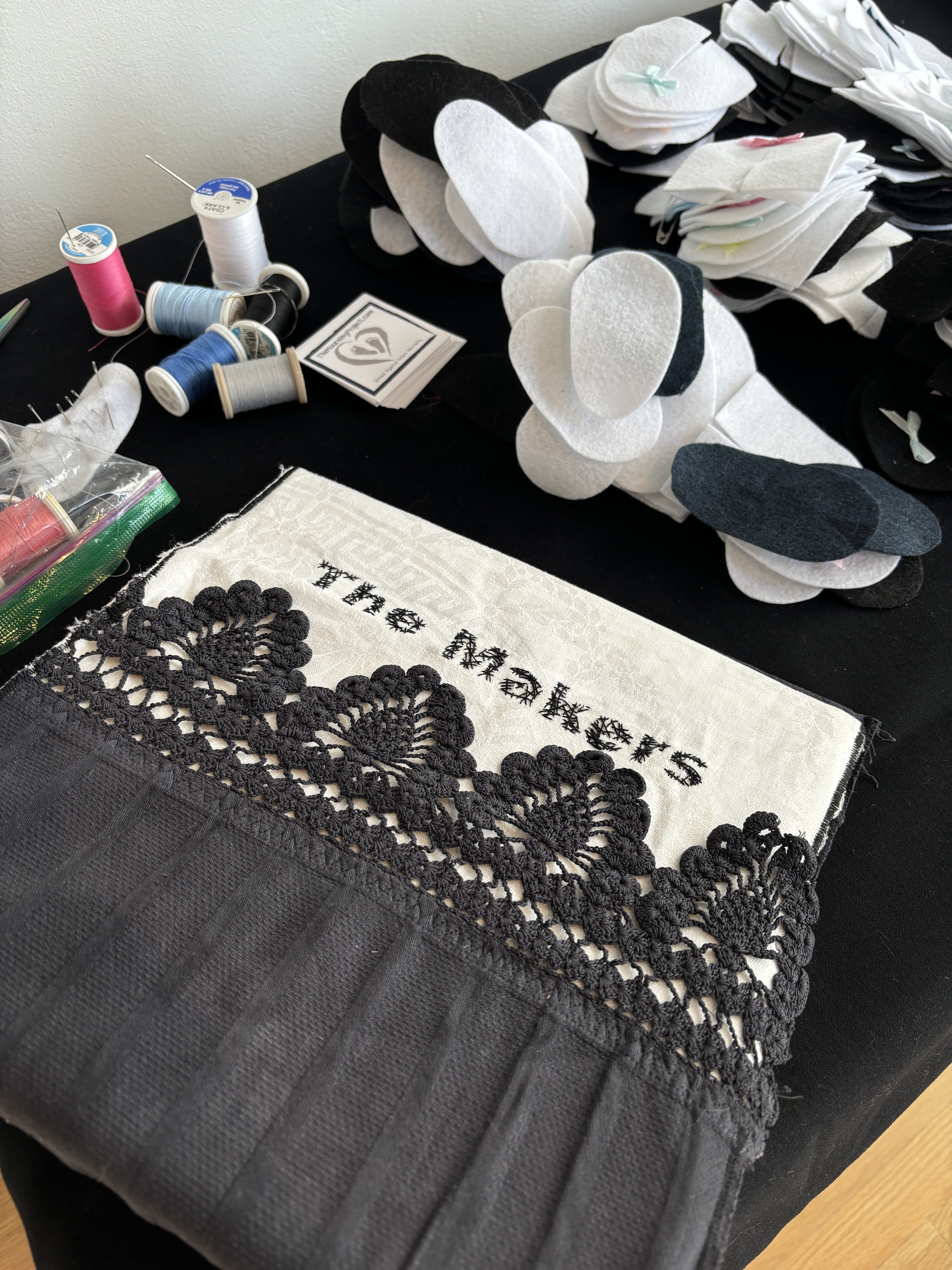
The Makers table

Carla and Gary Duncan with me at the installation

Carla Duncan helps installs the 'Mother Booties,' made in
memory of the 700+ American mothers who die from childbirth-related conditions.

the Mourning Project, detail

The butterflies await their release

Mary Vaneecke with Kendra Copanas of Generate Health and
Erin Coppenbarger of March of Dimes 


Installation view with the 'Thrive' Wall, which highlights the
work of some of the agencies combatting infant mortality across the state

A pair of booties made in honor of the thousands of infants
born into homelessness each year.  

The Mourning Project, detail

Art Cloth Network members created over 100 pairs to contribute to the project.  My thanks to all those who helped make this possible. 💜

For more information about the issue and the Project, go to www.MaryVaneecke.com


#20000BabyBooties     #UnitedAgainstInfantMortality    #BlanketChange


Saturday, May 11, 2024

Artist talk with Elise Findlay in Canmore - by Regina Marzlin

  While we met in Canmore, Alberta, for our annual in-person meeting we had the opportunity to listen to an artist talk by emerging fibre artist Elise Lavallee Findlay. We convened at the Arts Place in Canmore where her exhibition "Another Life" was on display. Elise is located in Banff, Alberta, just a short drive away from our meeting location. She is a visual artist known for her versatile, process-driven practice. Her work is centering around the themes of community, place, identity, and the intricacies of human interaction with the world. 


The exhibition we saw was motivated by Elise's experience as a wood worker and cabinet maker. The series of pieces was started during the pandemic and Elise used some materials she had at hand during the lockdown. She pulled threads from drop cloth canvas material and stiffened it with cornstarch after shaping it around objects. The objects she depicts are woodworking tools that she used in her former job.

This is her artist statement about the series:

"This body of work began with an examination and a sculptural expression of my past experiences, and by extension, the challenges faced by women working in the construction trades. Through material and process I explored memories of my previous life, resulting in a series of fibre sculptures, which, while referencing woodworking tools, have become strange canvas shells. Each sculpture is a duplication that is and is not. The installation represents a place that no longer exits for me, yet it also is a starting point. Something here goes beyond the original idea and the process. It is a beginning, a way to explore transformation, and how, while I used to be a cabinetmaker, like the sculptures themselves, I am now something new."


Larger sheets were produced in the same way and then stitched into 3D models of woodworking tools like a band saw or a work bench. The pulled threads are part of the installation, they are scattered on the floor to resemble saw dust.


 I was impressed with the concept of using the humble material to convey her thoughts about a male dominated workplace. Deconstruction, reconstruction and transformation are key processes of Elise's art making. She also brought with her a body of work that is going to be shown at the Canadian War Museum in Ottawa, Ontario. The exhibition is "Outside the Lines - Women Artists and War" and her pieces were made in response to some of the artifacts shown in this exhibition. It was thought provoking to see a gas mask (see photo above) or shells made from the light and transparent fibre material. 

She also showed us a birch bark piece that was stitched.


Elise was a great and inspiring speaker and we had lots of questions for her. It was wonderful to connect with a fellow fibre artist. Please look up her website at elisefindlay.ca if you're interested to see more of her work.


Wednesday, April 24, 2024

Art in Cuba by Connie Tiegel

 On a January 2024 trip to Cuba I met an artist named Yudit Vidal Faife. You are in for a treat when you checkout her website: www.yuditvidal.cult.cu 

Touring her house/studio in Trinidad, Cuba was a dip of the toe into the cultural waters of the embroidery tradition in Cuba.


In addition to making her own art she also teaches community classes to pass on the embroidery tradition to younger women.

In a country as poor as Cuba she has a great need for donated supplies of fabric, thread and needles.

Please contact Yudit Vidal Fiefe at: vidal.yudit@gmail.com if you would like to contribute supplies to her community projects.

by Connie Tiegel 

Saturday, April 13, 2024

Natural Dye Club by Dianne Hricko


 Please check out the link below for the amazing group show from the Dyers Club that my daughter, LauraVHricko linktr.ee/Lauravhricko is part of. These artists are from a wide variety of fields. They meet once a month to study and promote natural dyeing and working with fabric. 

The show is so beautiful and also educational. The link has lots of photos and useful information. 

It's open now if you are in Philadelphia. 

https://davinciartalliance.org/a-shared-table-eff


Dianne


Saturday, April 6, 2024

Displaying Daily Practice Art by Barbara James

Like many textile artists, my daily art practice is comprised of making small 4”x 4” compositions out of my hand dyed and printed scraps of fabric. I do not try to make these perfect, but just play with my fabric and the composition. Each piece has raw edges and the elements are hand stitched in place.  By making these little art works I keep the creative juices going between making larger works. 


These little treasures stack up in my studio and I often wish that they could be displayed. While browsing my local hardware store I thought of a solution-window screening. 


Here is what I did to make a larger piece. Window screening comes in convenient rolls. I cut a piece of screening to measure 22”X 44” and turned the top back 1.5” to form a pocket for hanging on a plexiglass rod.


I mounted each small composition on a 4.5” piece of black felt to form a mini frame. It was fun to hang the screen on my design wall and move the pieces around to determine the best placement for each piece. 


Once I was satisfied  with the composition I hand stitched the small pieces in place using invisible thread. Here is a photo of the back of the piece.


 To help to provide connection between elements I cut small bits of fabric and screening and sewed these in place.


The finished work is whimsical and a creative way to journal my work.


For more art by Barbara James visit my website at <barbarajamesart.com>.


Saturday, March 23, 2024

Breaking the Boundaries of my Comfort Zone with Natural Dyes - by Sue Sherman


One of the most fundamental forks in the path of any career is the choice to be a generalist or a specialist.  Do I try to learn a little bit about a lot of different specialties in my discipline? Or do I try to become the absolute best I can be in a very narrow niche?  In my first career I took the former; it was a good choice as I got to work on quite a lot of different kinds of projects, and it also provided a great foundation for managing multidiscipline projects. 


But when I retired from my first job and started a serious career as a fibre artist, it didn’t take long for me to realize that I wanted to try the other fork in the road this time.  After about a year of playing the field, I settled on an artistic technique (painting with thickened dyes) and started developing a style of my own (creating realistic looking fibre art featuring animals based on my own photographs).  And a couple of years after that I specialized a little further by (mostly) creating art that makes a statement about the environment, like the quilt shown above (from 2023) with penguins using their vote to have a say in their collective response to climate change.  I have now been following this very specific path for a few years now, and it never ceases to amaze me how much more I can learn about doing this one thing – the rabbithole keeps opening up more and more opportunities as I dig deeper into it! 

So why would I want to learn a completely new technique?

Well . . . my concern for the environment always brings me back to the way in which I do my work.  In particular the dyes I use, Procion MX dyes, are synthetic dyes that involve the use of chemicals to bond with the fibres to create those rich, strong colours.  These dyes also require quite a lot of water for preparing, dyeing and washing out. 

The alternative to synthetic dyes is to use natural dyes, using bits of plant and rusty nails to create lovely patterns on fabric.  As a member of the Art Cloth Network I have seen some truly amazing work by other members who are masters of natural dyeing processes.  Natural dyes have always intrigued me, but seemed to involve a bit too much witchcraft and forest lore, and anyways I was pretty sure they couldn’t be used to create work within my selected niche.  But finally the siren call of the unknown was too loud to ignore, and it seemed a good time to take a class in natural dyeing just so I could finally set aside that thought and be content making realistic artwork with my chemical dyes.

Good thing I’m able to admit when I’m wrong!  Well, not about the witchcraft and forest lore part, but who knew that natural dyes could be used to create realistic artwork on fabric?  I signed up with Maiwa.com for their online class “Printing and Painting with Natural Dyes”.  It was designed around some simple methods of applying colour to fabric using thickened natural dyes.  Methods demonstrated in the online videos included block printing and painting simple shapes onto fabric.  But by using my own brushes (which range from teeny-tiny to medium sized) and my library of animal photographs to do the class assignments, it became evident that there is a lot of potential here! 


Natural dyes are more complicated than chemical dyes.  No doubt about it.  For starters, they don’t come in jars labelled “yellow” or “red”, but by the names of the plants (or bugs) they contain.  You need to learn how to prepare each raw material to create the liquid dye, and how each one reacts to tannins or iron.  Some need to be boiled and extracted, some just mix with water; some need to be strained and some not.  And you need to know about mordants and how to apply them to the fabric where they will react with the dye.  Bottom line, you can’t really be sure what you are going to get with a particular dye on a particular fabric using a particular method until you test it, so you need to keep good notes of what you did to create each colour, as shown in the above sampler.

And when the process is complete you will need to steam your fabric to heat set the dyes for a permanent bond, and which also modifies the colour of some of the dyes.  We used a bamboo steamer over hot water, for 30-60 minutes depending on the piece.  And depending on the method used to prepare and dye the fabric, you may need baths of chalk or bran or plain water to initiate certain reactions.  Yikes!  But in the end you can do some really great things with it.

I’m just at the beginning of exploring this particular branch of my rabbithole, but here is what I have found so far:

First and foremost, you can get a really good black with myrobalan and iron.  Given that my work involves a lot of penguins and a few zebras, this is no small thing.  I have never been able to get a true black with chemical dyes – it usually turns out as a very dark navy blue.  You don’t necessarily notice it to look at, but I can really tell when I go to stitch on it and the black thread doesn’t match. The zebra below was one of my first pieces painted with thickened natural dyes, and you can see how true the black stripes are.  The test splotches on the bottom are of four different natural dyes that come out black or close to it (myrobalan, gallnut, pomegranate and cutch) that I was auditioning for this piece.  I'm looking forward to getting this under my longarm for some thread painting!


Second, this class introduced me to painting with thickened dyes on silk and linen, and investigating how the colours look on these other fibres.  (To be clear, I could probably have learned how to do that with my thickened chemical dyes but just never got around to it.)  I love silk and linen, and can see this opening up a whole new area for me. 

The three images below are of the same rose created with mostly the same natural dyes on three different fabrics.  The second and third images were painted at the same time - the thin silk on the top allowed residual dye to pass through it to the lightweight cotton below.  I'm still trying to decide what to do with these.

Rose on heavy natural (unbleached) cotton

Rose on silk


Rose on lightweight cotton that was
underneath the silk when I painted it.


On the downside, I find the natural dyes to be much more difficult to clean, and much less forgiving if you happen to leave them too long before trying to remove them from brushes, palettes, mixing tools and my laundry sink.

And another downside is that natural dyes use a shocking amount of water in the various pre- and post-dyeing baths, not to mention the heat of dye preparation and steaming the finished pieces.  I still think that if you look at the total environmental impact of the two types of dyes, from manufacture through to disposal, the natural dyes are probably better, but not by the clear margin I was expecting.

I will definitely be adding a variety of natural dye techniques to my toolbox moving forward, especially for artwork involving penguins.  The piece below is 12"x12" and features a penguin image created using natural dyes.  The frame is part of the same whole cloth, and was created by painting with metallic fabric paint.  I then trimmed very near the quilting stitches and finished the edges with more metallic paint. 


 click here for Sue's website