Showing posts with label art quilt. Show all posts

Friday, November 15, 2024

"Quilted and Carved" Artwork by Sue Sherman

I have recently been dabbling in a whole new way to give a voice to the wild animals I have photographed, by framing their images in a way that may be meaningful to them.  The technique is an extension of what I have been doing for the past 6 or so years: using thickened dyes and heavy thread painting to create realistic animal portraits.  

What’s new is that I’m adding a frame to the portrait.  The frame is created with metallic fabric paint, quilted, then closely carved (trimmed) close to the stitching lines.  The edges are then finished with matching paint to create an integral frame that’s a reasonable imitation of a real one.  Using this technique I can create whimsical, meaningful or slightly wacky frames, each one unique and matching the character of the portrait.

The portrait starts with a photograph, from which I have created a line drawing.  The line drawing is then traced onto fabric treated with soda ash, and then coloured with thickened dye applied with paintbrushes, to create a face as realistic as possible.


After the dye has worked its magic and has been washed out, the frame is outlined onto the fabric and painted with metallic fabric paints.  For a 3D look, I usually include some shading and highlights in the paintwork.

For the cardinal's frame, I created a natural looking design by tracing actual maple leaves that had fallen from the tree in my backyard.  I then painted them using a mixture of gold, brass, bronze and copper metallic paints for a natural looking mix of colours, reflecting the way the leaves looked on the tree in October.


After quilting, I trim the edges very close to the stitching and then finish the edge with more fabric paint.  If you look at the below picture you can see that the loop of chains on the left has its edges finished, but the edges of the loop on the right are still white fabric.  This step is just a small detail, but it makes a big difference to the finished artwork:  it stops the edges from fraying, it covers up the remaining bits of white fabric, and it stiffens the piece just a little more (which helps it hang nice and flat).  After this step, it is usually necessary to trim off some remaining frayed edges.

The whole process takes a long time to complete and is very finicky but I’m very happy with the results.  Here are a few examples of finished pieces using this technique:

For this king penguin, I thought its regal name deserved a regal looking frame.  This is a smaller quilt than the others (only 12”x12”), and it was made for the 2024 SAQA Benefit Auction. 


Here’s a hornbill photographed in Kenya.  The most notable thing about him is his spectacular beak, so I wanted to make sure it was the most attention-grabbing part of the piece.  The best way I could think of expressing this was to have it be just too big to fit into the frame.  


The emu has so much attitude, it just needed a punk frame featuring chains, skulls and spikes, around a studded black leather band.


The puffin is framed with tiny sand eels, their favourite food!  The silvery eels worked out very well in silver and gold metallic paint.


The cardinal’s frame is a reflection of my association of this beautiful bird, photographed in our backyard, with the maple tree where it spends a lot of time.  It’s the most natural-looking "quilted and carved" portrait I’ve done so far, and definitely the most complicated.  I really enjoyed making him!


This is becoming a whole new avenue of fibre and stitching creativity. I have so many ideas for the future!  

You can see any future pieces in this series by following me on Facebook or Instagram (sueshermanquilts).  If you don't do social media, you could email me at sue@sueshermanquilts.com and ask to be added to my newsletter list.

by Sue Sherman

Wednesday, February 28, 2024

SACRED MUSE by Mary-Ellen Latino

As part of the Westies group, which is a subgroup of Art cloth Network and comprised of artists mostly from California and Canada, I have created a piece from a call entitled, “One Long Earth Song”. Each artist was prompted to read “Benedicto” by Edward Abbey for inspiration and create a piece 36” (W) and 18” (H) by 2/29/24.

I decided to create a piece to highlight such wonders of Mother Earth in the Petrified National Forest in Arizona. While visiting there, I was captivated by fossilized logs and stumps that had metamorphosed from trees over a period spanning 200 million years. Bursting with magical color, texture and glimmer, they exemplify powerful strength and perseverance in the face of adversity. These petrified beauties are gifts we will treasure forever.

I digitally developed a photo I had taken in the forest, commercially printed, machine stitched and fused (gilded) the log with multiple layers of metallic foil.

Here is the piece in progress as I apply foil with heat to develop surface design.


After several days of applying the foil in many layers using Misty fuse and heat, the piece is done!                 

                                                                     SACRED MUSE

Here are  3 detail views of SACRED MUSE:

SACRED MUSE, detail 1

SACRED MUSE, detail 2

SACRED MUSE, detail 3

One of my favorite poet and authors is John O'Donohue (1/1/1956-1/4/2008) who was an Irish poet, author, priest and philosopher. His writing also speaks to me about this piece.

“THE BEAUTY OF THE EARTH IS THE FIRST BEAUTY. MILLIONS OF years before us the earth lived in wild elegance. Landscape is the first-born of creation. Sculpted with huge patience over millennia, landscape has enormous diversity of shape, presence and memory."

SACRED MUSE is the second piece in the Petrified Log series. I plan on creating more pieces in this series.

PETRIFIED LOGS (diptych) was juried into the ACN exhibition LAYERS in 2022 by juror Lasse Antonsen.


                                                                     PETRIFIED LOGS 

“The tree is more than first a seed, then a stem, then a living trunk, and then dead timber. The tree is a slow, enduring force straining to win the sky.” Antoine de Saint-Exupery

by Mary-Ellen Latino

Saturday, July 1, 2023

Sustainability and Activism in Art, by Sue Sherman


I recently returned from a whirlwind few days in Halifax, Nova Scotia, for this year’s Quilt Canada, the main annual event of the Canadian Quilters Association/Association Canadienne de la Courtepointe (CQA/ACC).  During this time I was also blessed to finally catch up with Luana Rubin, a force of nature within the quilting world.  More about that later.

CQA/ACC is the first quilting organization that I know of to assign an Award of Excellence for Sustainability.  This was not just a ribbon and a smile, but a full-on $1000 cross-category award equal to the Awards of Excellence for piecing, appliqué, innovation, hand stitching, and the two machine stitching awards. CQA worked with well-known Canadian Quilter Bridget O’Flaherty, aka The Sustainable Quilter  to develop criteria.  The award was either for the use of recycled/low-impact construction methods or materials, or for artistic content with an environmental or social message.  Show entrants in all categories were asked to check upon registration whether their quilt should be considered for this new award.

When I signed up to write this blog post earlier in the year I was always planning to make it about the new CQA/ACC Sustainability Award, so how wonderful is it to say that one of my quilts won it this year!  

The quilt is called “Sanctuary?” and it’s an absurd look at a future where Antarctica has warmed up to the point we have to create an artificially cooled environment in order for penguins to build their rookery.  The scene shows a geodesic dome covering the penguin nests, with a coal-fired furnace next to it spewing black smoke into the atmosphere to power an air conditioning system. The effect is quite dark but, I hope, amusing at the same time.  And what’s not to like about a quilt that's six feet wide with over 100 penguins on it?

We should also recognize that this year’s Sustainability Award of Excellence was sponsored by the Etobicoke Quilters’ Guild (Etobicoke is a part of Toronto).  This is a big commitment for a quilt guild and says a lot about their commitment to using quilting as a voice for change.  Bravo!

The judges at this year’s Quilt Canada may have made a further statement about the place of activism in quilt art by awarding Best in Show to another one of my recent activist pieces, “Life in the Anthropocene”, which is described in the April 6 blog post ArtCloth Network: Life in the Anthropocene.

Back to Luana Rubin, she has been a great supporter of quilting and quilters for many years through her company eQuilter.com, an incredible source of quilting fabric and other necessities that has committed to giving 2% of every sale to charity.  As one of the owners of eQuilter, Luana has sponsored many quilting and art quilt events over the years, and she has spoken extensively to the art quilting community around the world about including an activist element in our art. 

All of this encouragement of art activism is having an impact.  I used to feel the need to apologize for including an opinion in my artwork, but not so much anymore.  And other art quilters have also told me they are feeling less timid about expressing their views in art, and that viewers are responding positively.  As events unfold in what climate scientists have identified as the last decade where it will be truly possible to save the world from the worst effects of climate change, my plan for the near future will be to slowly increase the volume of my artistic voice.

You can see more of my work at sueshermanquilts.com.

Wednesday, April 12, 2023

Life in the Anthropocene by Sue Sherman

 
This quilt started out as an idea that would not go out of my head.  A bunch of animals standing on various platforms in space – clearly not places they could live for any length of time, the point being that the way humans encroach on habitats of wild animals does not consider whether the resulting ecosystem will work for them.  The image seemed absurd to me, and I resisted the urge to turn it into a piece of art because it just didn’t seem that it could make sense to a viewer without a lot of explanation.  But the idea wouldn’t go away, and so I got out a pencil and a really long ruler and started working with vanishing points on a large piece of paper. After several modifications of the horizon, the vanishing point locations, and the shapes, I settled on a version in two-point perspective with three complex 3D shapes that complemented each other in space but did not touch.  On a couple of the large flat surfaces I made little cubbies for smaller animals.

Before drawing any animals I worked out the relative sizes that the animals would have to be at various points in the perspective, which is not as hard as it looks.  All the vertical lines connect parts of a shape that are the same distance from the viewer.  Any horizontal or vertical surfaces are wider towards the front and narrower towards the back – I used the ratio of the relative widths/heights of these sections to figure out the ratios the animals would need to have to each other.  And on top of that, I needed to look up the sizes of each animal in real life so they would all be of the correct size relative to each other.

Next I went into my database of photographs from my travels to find wild animals that would work on the quilt.  It was helpful that the background shapes have some “floor” surfaces above and some below the horizon, so I could place the various animals on the shapes according to the viewpoint from which they were photographed.  I created a line drawing of each animal on tracing paper, and stuck them on the background using repositionable tape.  I had to dig deep for the photographs as it needed quite a lot of different animals to fill the space.  Some of the images weren’t very good, but it turned out they were good enough to use at this small scale.

Next I used coloured pencils to transfer the entire image onto white cotton treated with soda ash, and brought the images to life using paint brushes to apply Procion MX dyes thickened with sodium alginate.  The thing with dye is that once it is applied it is really difficult/impossible to remove, and there is no painting one thing “in front of” another thing.  You need to dye paint the thing in the front first and then carefully dye paint the thing behind it by filling in the negative space.  For example, if you look at the ferns next to the zebras, the ferns were created first and then I applied the orange of the planter all around the fronds using a very fine brush.

Once all the animals were created using the thickened dye, I filled in the geometric shapes behind them, and then the sky-coloured background.

Quilting this piece was fun!  My quilting and thread painting are one –the thread you see in the front goes through all layers to the back, which means that I need to pay a lot of attention to keeping the layers nice and flat.  I start in the middle and work out, and change thread frequently in an effort to keep the quilted area fairly round.  Each animal has its own approach to thread painting, to try to get the fur, feathers or scales as realistic as possible. The larger animals were done using trilobal polyester, but for the smaller ones I needed to use 100wt. silk to get the required definition.  This was also true for the giraffe, so that I could make realistic thread-painted fur on its individual spots.


I would like to draw your attention to the beautiful rhino at the very front.  His name is Baraka and he lives in the Ol Pejeta Conservancy in Kenya.  Baraka lost one eye in a fight and lost sight in the other one due to a cataract.  (With apologies to Baraka, I have flipped his image to fit the perspective -- it’s actually his other eye that’s missing!)  It seemed somehow poetic to have a blind rhino at the precipice, symbolically leading the entire group into the unknown.  Baraka is also a very hopeful image:  he is especially vulnerable in a country where rhino poaching is a constant threat, yet he continues to thrive due to the care and support of humans who are trying to make a difference. 

This piece has a lot of background, and I struggled to come up with something meaningful to put there.  All-over wavy lines or swirls just wouldn’t be enough to complement the images in the foreground.  It seemed that the unseen animals, the ones that have already gone extinct due to human activity, needed to be a part of the story.  Not being able to take my own photographs of extinct animals, I could not create their ghostly images in thread, so I quilted their names all over the blue sky background in various sizes of cursive writing.  Researching all these names was humbling and sad. 

It was tough to come up with a name for this art quilt – Life in the Anthropocene seemed to nail down what I was trying to say, but I worried that people would need to look it up.  On the other hand, this unfamiliar word is a great conversation starter, and looking it up may help viewers learn a little more about why scientists are saying we have moved away from the Holocene Epoch and into the Anthropocene.

The finished piece is 63” high x 73” wide.  If you missed it at the Branson Quilt Show last month perhaps you can see it at the upcoming Paducah Quilt Show later this month.

You can see more of my work at www.sueshermanquilts.com.

Saturday, October 1, 2022

Angry Birds Haiku by Mary Ann Nailos


I was playing around with idioms we use every day and thought about the expression “Killing Two Birds with One Stone.” What would a bird think about this? This inspired me to write the following haiku “Know the Expression – Killing Two Birds With One Stone? Birds are Not Big Fans. This is the  basis of the quilt Angry Birds Haiku.


The inspiration for the piece was both the poem and the fabric with the feathers printed with thickened dyes.


 I needed some squawking birds so searched for images of crows and seagulls. I used a flour paste resist for the birds so they now look like a cross between seagulls and grackles.

Lots of hand stitching on the birds, feather fabric and the text.

The final design element is machine quilting. They looked pretty ticked off, don’t you think? Can’t say that I blame them!


Saturday, June 11, 2022

Away from Clay - When One Door Closes by Mary Ann Nailos

     In addition to ACN, I am part of another art group called Stretching Art. The group puts out a call for entry once a year. Last year’s theme was “When One Door Closes”. I was a potter for about 20 years and most of my pots were hand built, mostly constructed from slabs. I rented studio space in my friend Richard Hess’ studio. In 2013 he informed me that he was moving to Illinois, so I either had to find another place to do clay, or find a new artistic practice.

     Doing clay at my house was not an option. I decided to go back to my first love – textiles. I started taking classes in traditional quilt making, then surface design, that then lead me to Jane Dunnewold’s Art Cloth Mastery class. 

    There are similarities between slab built pots and quilt making. These pots were made with a template on a flat piece of clay. Quilters cut shapes out of fabric and make quilt blocks. Different firing techniques and glazes differentiate the pots. Quilters use different fabrics and Art Quilters use different surface designs to create their quilts.

I printed textures onto black and colored fabric using Thermofax screens that I designed. Then I cut the pieces from the colored fabrics using the Notan method, fusing them to black fabric. After that I added stamping from various stamps that I made.


This is the finished piece below that I named Away from Clay. As the door to pottery making closed, the door to Art Quilting opened.


Saturday, May 28, 2022

The Migrant Quilt Project Comes Home by Mary Vaneecke

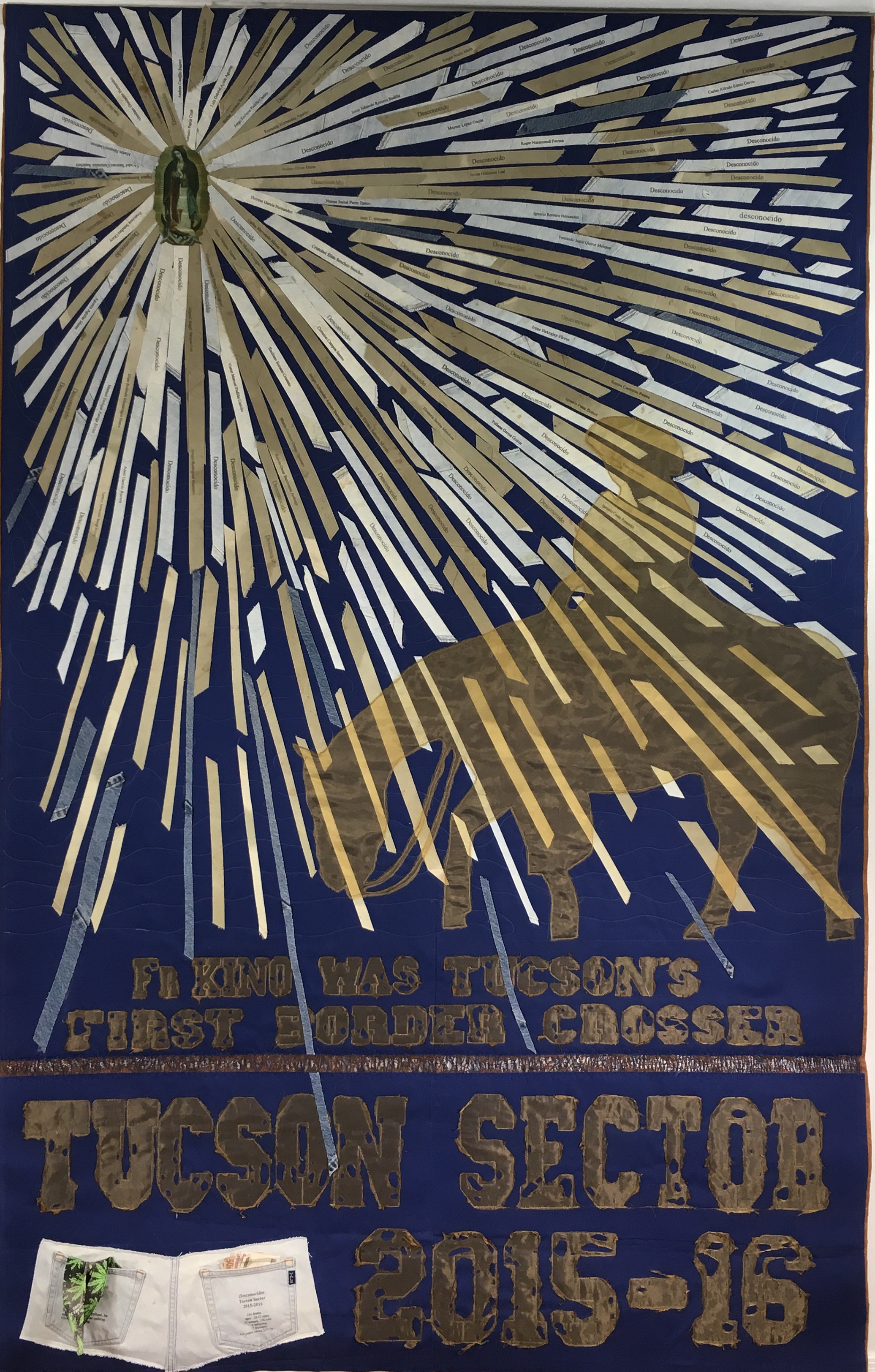
The Migrant Quilt Project memorializes migrants who have died seeking refuge in the US.  Every year, the Project recruits a volunteer artist or organization to create a quilt made from clothing abandoned by migrants along the border near my hometown, Tucson.  Each quilt carries the names of those whose bodies have been identified, or the word 'desconocido' ('stranger' in Spanish) for those whose remains are unidentified.   

My contribution to the project covers the fiscal year 2015-16 and honors the 144 people whose bodies were found at the border that year.  It features an image of Virgin de Guadelupe, and a silhouette of Fr. Eusebio Francisco Kino.   Fr. Kino was the first European in the area that is now Tucson, and is in my view the first border crosser here.  Creating this work was a humbling and sobering experience.  

Desconocidos, by Mary Vaneecke


The Migrant Quilt Project is back in Tucson, Arizona after a tour around the country that included venues in Massachusetts, Michigan, Illinois and Washington D.C.  The exhibitions drew national attention and were featured in articles in the Associated Press, New York Times, LA Times and the Washington Post.  

The Arizona Historical Society recently acquired the entire MQP collection, which is on display now through February 2023.  The exhibition is the first chance for the public to view the 2019-20 quilt, 

For information on the current exhibit, click here

To see more of my work, click here:  www.maryvaneecke.com 


Saturday, February 12, 2022

Line Dancing with Barbara Schneider

Line Dance, Tree Ring Patterns, var. 26 is 57" x 43". It is an art quilt.  It is created from a photo of a tree stump I took while walking in one of the local conservation areas. I loved the look of the "feathers" in the wood caused by some unknown issue in the tree's past.  These old tree stumps are evocative, for me, of time passing. I wonder at all that has happened in that forest - what has come and gone, what the tree has survived and been used for.  Some of the story gets told in the stump by the markings.  As part of my interest in Wabi-Sabi, the Japanese concept of finding beauty in the imperfect, the old, the decaying, the moment, I find this beautiful.


I manipulated the image in Photoshop Elements to heighten color and contrast, printed it out and then thread painted all the black line area to add dense texture and contrast to all the other patterning.  I find the back of the piece quite intriguing as you see the map of that stitching.  It tells you even more about the interior life of the tree.


See this piece and more in the Line Dance series on my website:

www.barbaraschneider-artist.com


                                                                      ---Barbara Schneider


Line Dance, Tree Ring Patterns, var. 26, reverse

Line Dance, Tree Ring Patterns, var. 26, detail

Line Dance, Tree Ring Patterns, var. 26


Saturday, February 5, 2022

Barbara Schneider Explores Desert Variations

Leaves, Desert Variations is a based on photos taken in the desert. It is an art quilt. 54" wide x 30 " high. It was printed on polyester and batted and backed. This low to the ground photo had such striking contrast between the two plants and density of color and texture.  The interplay of the plants is striking.
Leaves, Desert Variations, by Barbara Schneider, 30''h x 54''w