Showing posts with label gelatin monoprinting. Show all posts

Saturday, November 23, 2024

A long time in the making - by Regina Marzlin

 One of my favourite surface design techniques is printing with a gel plate on fabric. In 2019, I got a large 16"x20" printing plate and worked with it for the first time at a group retreat in June 2019. I made some really exciting prints that I loved and wanted to use in my art pieces.

Alas, the fabric was too precious and also difficult to combine with anything else that I had in mind. Off it went into the pile of printed fabrics, not to be seen again for a while. 

I tried to make a composition in March of 2022, here is the picture.


The fabrics were mostly not sewn together yet, and I couldn't get a good composition on my design wall. I tried more unsuccessful combinations, over the span of a year or so, and just couldn't get it right. Back onto the pile with the fabrics!

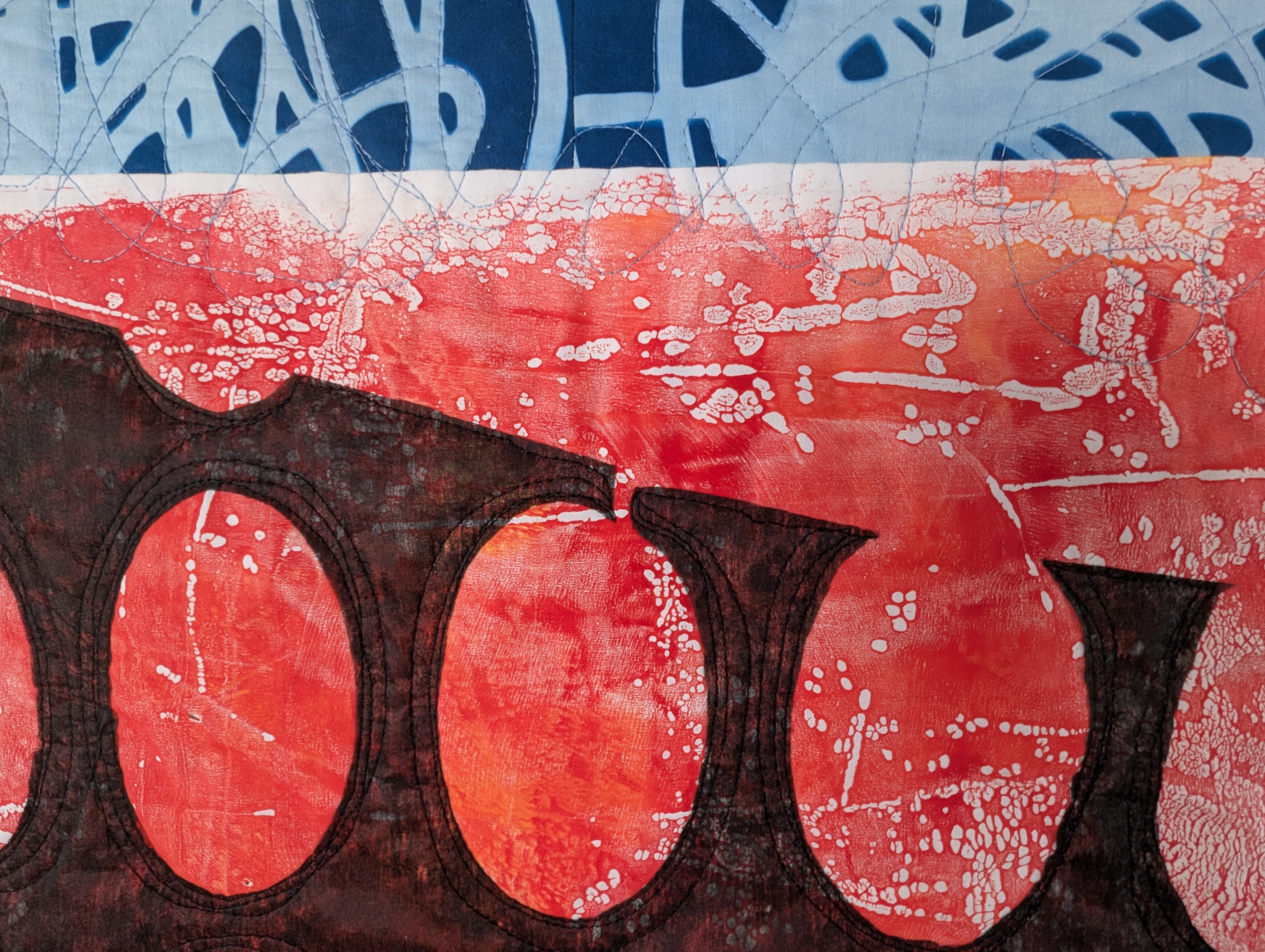
The Art Cloth Network call for entry for our 2024 exhibition "ReVision" finally gave me the push I needed. I was going to make those fabrics work. I didn't change the colour scheme, as I loved that, but rather introduced new elements, like cyanotype prints and transparent overlays, and really worked hard to achieve a good composition. In the end, I created two artworks I was happy with, and both got accepted into our exhibition. Sometimes, the waiting is as important as the making. 

Here are the two pieces.

Opposing Forces 1
w.23" x h 32.5"


Opposing Forces 2
w 20" x h 42.5"

And some detail shots:


Friday, November 3, 2023

Starting a New Series - by Regina Marzlin

Detail of "Who Are You, Really?


 The latest Art Cloth Network call for entry is titled "Blurred Boundaries". My ideas were swirling but I finally settled on working with the human figure, which I rarely ever do. But the theme begged the question: how clearly can we see another person, or are we just left with a blurry, unfocused image of someone? The way we perceive each other and present ourselves in the world is for some reason interesting to me right now. Sometimes you just have to follow up, however weird it seems at first. 


I decided to once again use my preferred method of printing the fabric using my gel printing plates. I hand-cut a lot of stencils, taking silhouettes mostly from sewing and fashion magazines, as I wanted to emphasize the posing that people do.


I then used the stencils to try out multi-layered prints, that were offset so the shapes overlap, and get unfocused.


It worked the way I wanted! This is not always the case, so I was happy with that. I proceeded to print and made material in different colourways so I could make more than one piece. I finished two new pieces and have a feeling that I'm not done with the ideas and will add more to this new series. 
Here are a few more detail shots:


Detail of "Performance"


Detail of "Performance"


Detail of "Who Are You, Really?"


Sunday, September 3, 2023

Talk about your art! by Regina Marzlin

Field Notes 1-20

In the fall of last year, I drove to a small art gallery about an hour's drive away from my home to see an exhibition. The work shown was by a Nova Scotian painter and printmaker, Bob Hainstock. I admire his abstracted landscapes and his use of colour. While I was looking at the exhibited pieces, I got talking with the gallery owner. We had a very nice chat about the artist's work, what I admired about it and how I thought it related to my own work. She asked a lot of questions about my own work, not having heard of me before. 

My visit took an unexpected turn right there! She asked me if I was interested in showing in her gallery in the next year, and basically offered me a solo show on the spot. I was very surprised and agreed, of course. The space is great, it would be wonderful to have the whole gallery to myself and fill it with my art. I drove home with my head spinning, and wondering if it all would work out. The gallerist really hadn't seen my art at all, so I just hoped she wouldn't renege on her offer.

Fast forward one year, and my exhibition opened on August 28th, 2023. I'm very happy to have this opportunity to see this body of work in one room, and for other people to get to know my work as I hadn't shown in this area of my province so far.


The body of work I'm showing has been made during the last four years and mainly consists of stitched collages made with my monoprinted fabrics. These prints are made with natural material that I collect and is a snapshot of my immediate surroundings. The title of the exhibition is "Field Notes", referring to the character of a botanical expedition and exploration of the nature around me. 

I will also teach a class about mono printing with natural materials at the gallery, to tie in with the exhibition.

It is important to have some engaging words at the ready to talk about your art, to describe it to people even without the help of visuals so they can get interested in what you do. You never know where this will lead!

Field Notes: Hidden Away


 Regina Marzlin "Field Notes", August 28th - September 23rd 2023, Visual Voice Fine Art, Truro, Nova Scotia

To see all pieces in the exhibition, go to

Visual Voice Fine Art | Unique Works by Talented Artists (visual-voice.ca)


Saturday, November 12, 2022

Starting a New Series, by Regina Marzlin

 I want to share a new piece that I made for our current call for entry "Layered". I print a lot of smallish fabric pieces on my gel printing plates. To assemble them into a larger piece is a challenge, but I'm happy with the outcome of my latest explorations and want to continue doing more work in that direction. Fingers crossed that the piece gets juried into our next show!

The piece is called "Late Night Conversations", w 25.5" x H 37.5".


My artist statement for this artwork is this: "Thoughts are swirling and deep philosophical questions are pondered in late night conversations. We jump from one topic to the next, sometimes without any logic, only guided by our semi-conscious trains of thought. The world around us disappears for a while."

Materials used are cotton fabric, acrylic paint, and India ink. The process of mono-printing is my favorite technique to apply paint in multiple layers. To unify the prints I overpainted them with black India ink with swooping gestural application before piecing them together. Here are some detailed pictures:


The machine stitching is very subtle and doesn't compete with the busyness of the fabrics.

One surprising discovery was that the reverse side looked really intriguing, I was seriously tempted to declare this the front side for a while! Another avenue to pursue, for sure.


Saturday, September 10, 2022

Printing up a storm - by Regina Marzlin


Within our Art Cloth Network group, we have a good number of subgroups that get together virtually to discuss various topics, do critiques, talk about certain techniques and so on. One of these online groups is the Gelli print group. Members of this group are interested in using gel plates for monotype printing on fabric or paper. We often work alongside each other, happily producing a stack of prints while talking about technical questions, design ideas or art and life in general. I really like this informal concept of sharing a virtual studio with my textile colleagues. Our studio hours are usually so very quiet and we work in isolation. But in this group, we can hold up our freshly printed fabric for everyone to admire and we can all share our excitement when a print is successful. We also give each other useful tips and advice on the printing process.


These prints were nature prints done with different leaves and plant materials on white cotton fabric. I like to stick to a palette when I do these kinds of prints so they all harmonize.


The individual prints are all 6" by 6" and I have plans for what to do with them and how they will be presented at a sales exhibition in Nova Scotia this upcoming November. 

Saturday, June 4, 2022

Working with 3-dimensional elements


by Regina Marzlin (reginamarzlin.com)


I belong to an online international art quilt group called "Cloth in Common" (www.clothincommon.com). We are 12 artists from around the world, from New Zealand, Australia, Japan, South Korea, Germany, Netherlands, USA and Canada. Every second month, one of us gives out a prompt or theme, and everyone creates an artwork that responds to the theme. Our overarching theme this year is "Structures", so we had prompts like "Building", "Anatomy", and "Light". The latest prompt was "Cells", which led to some amazing artworks - you can see them on our blog.

I decided to go with red blood cells, as I find the biconcave disk shape appealing and the vibrant red colour is so lively. The finished artwork is titled "In the Blood", it is 25.5" wide and 39.5" high.


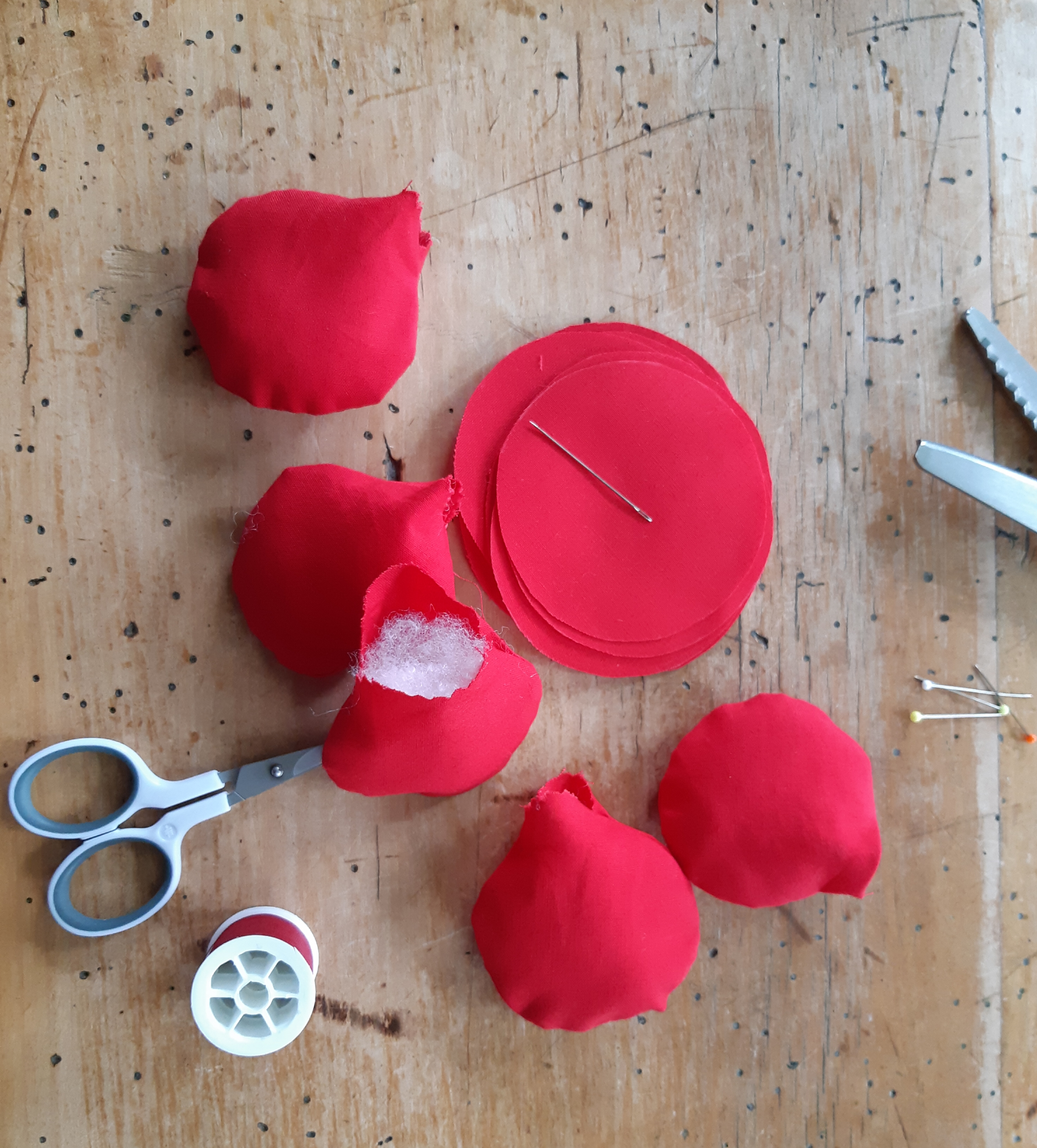
 I decided to actually make the individual disks as 3-D shapes to be applied to the surface of the quilt. Approximately 2.4 million red blood cells are produced per second in a human adult! That is a staggering number. I settled for the more manageable number of 44, and even that was a lot of work as it took me about 15 minutes to make one – cutting out, sewing the rounds, stuffing, sewing shut, and sewing the middle indent.


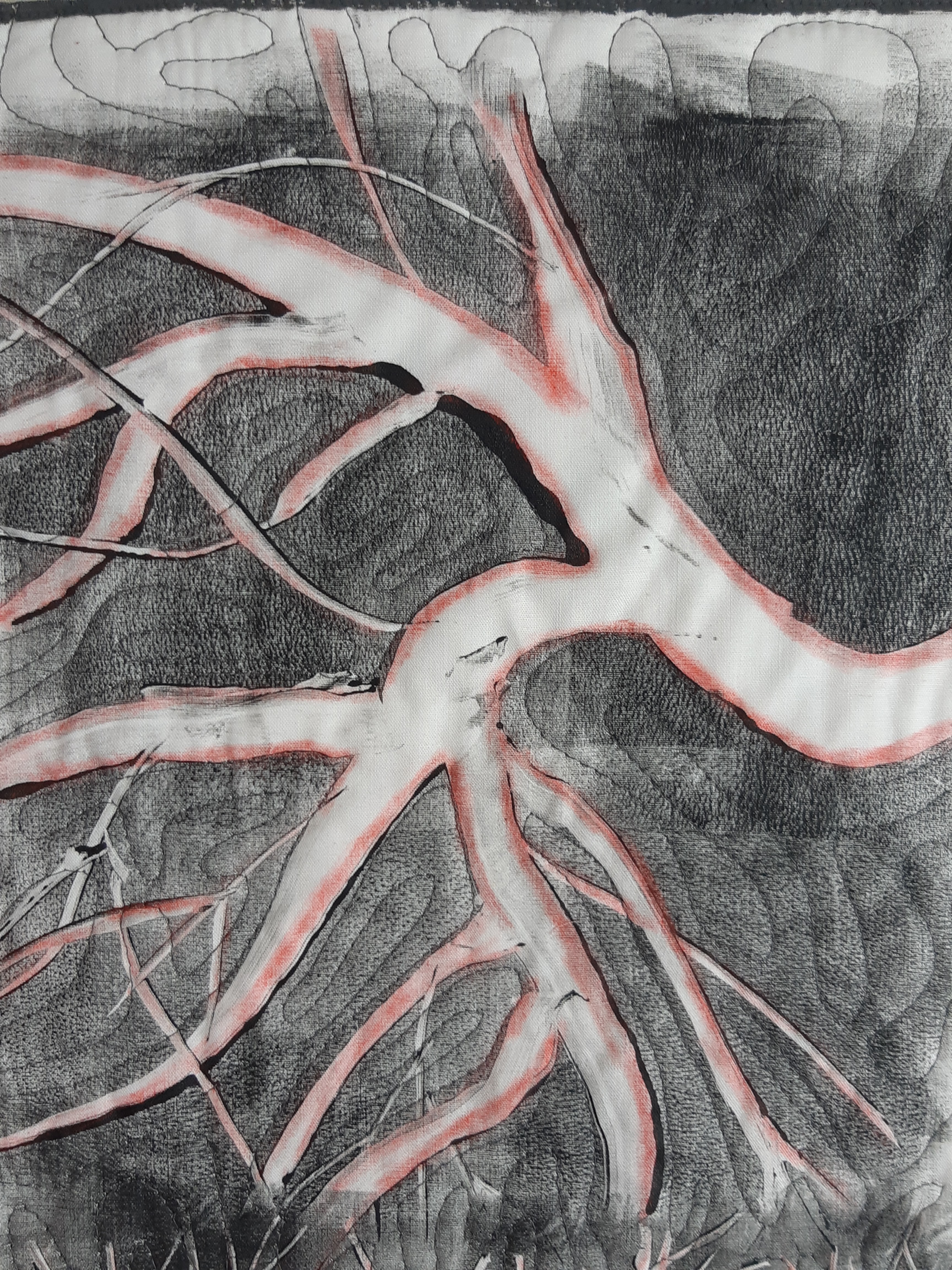
The black-on-white print of the blood vessels was done on a gel plate with acrylic paint. I printed two lengths of cloth to go on each side of the middle blood vessel. 


To bring in a bit more colour I decided to use a red Inktense pencil to outline the blood vessels.


It was fun attaching the blood cells to the quilted surface, I was able to overlap and stagger and really play with the three-dimensional idea of this design.


Title In the Blood
Regina Marzlin
Dimensions: h 39.5″ x w 25.5″
Material: cotton fabrics, acrylic paint, Inktense pencil
Technique: mono-printing, painting, applique, machine quilting

Friday, May 7, 2021

Jeanne Sisson's Subtle Layering Process on 'Carried'


Jeanne Sisson, www.jeannesisson.com


To start I ironed fabric onto freezer paper to stabilize it before drawing or painting. Then I used this Arabic calligraphy pen and India ink to draw the figure onto the linen.


The textures above and behind the figure are multiple layers of monotype printing with acrylic medium that will act as a resist when a wash of acrylic paint is applied later. The background was masked with freezer paper and textures were monotype printed onto the figure and foreground with paint.


Lastly, I applied a couple of layers of acrylic paint in washes to create depth.

Carried, 12 x 14”, mixed media on linen


Sunday, November 13, 2011

Monoprinting on the new Gelli Plates at the Houston Quilt Festival

I was recently introduced to Gelli Arts reusable gelatin plates, which are used to replace a "gelatin plate" made in a similar fashion to "Knox Blox", an ideal surface to perform monoprints on both cloth and paper.
These reusable plates are ideal for me when teaching in a place that is difficult to make gelatin plates from scratch. Plus, these do not require refrigeration!  The plates come in two sizes:  6 inches by 6 inches, and 8 inches by 10 inches.
The idea is to spread a thin layer of paint over the surface with a brayer, brush, or other spreading tool.  The paint can then be manipulated by a variety of stamps or other tools and the pattern can be "picked up" from the surface with cloth or paper.
Here are a few images taken during the Sketchbook Challenge workshop by Sue Bleiweiss  and myself of the round robin workshop in Make-It-University during the quilt festival.  Among the four technique stations featured, I taught gelatin monoprinting.  I gave each student two types of paper and two types of cloth to experiment with:
 Things are still pretty "neat" at this point!

paint is applied across the gelatin plate surface


students selected among the large variety of texture tools to create marks
left foreground:  student places her paper onto the gelatin plate to "pick up" the paint


After use, the plates can simply be wiped off with a damp paper towel and stored for future use.  Any type of acrylic paint can be used, and each print can be "layered" repeatedly by this method.