Saturday, May 13, 2023
Save the Date--by Mary Vaneecke
Wednesday, May 10, 2023
Pick Up Stix
Whenever I walk in the woods I pick up sticks or interesting pieces of bark, or anything else that looks like it will have either an interesting texture or a wonderful pattern or shape. Many of these become textile pieces further down the line. But some are just so lovely as they are that I have created a group of them called Pick Up Stix. I take the original piece of wood, clean it well and then coat it with a graphite solution made from powdered graphite, denatured alcohol and shellac. You paint it on (usually 2 coats) and then rub it with another stick or a coin to get the graphite to take on that beautiful gray sheen. I have added gold paint into the cracks for contrast and definition.There is something so satisfying about the feel of these pieces.
When I was in design school in the 60's!!!! we had a project in our first year to make a "feel good". You were given a hunk of metal and then you had to cut, file and sand it until it felt good in your hand. Let me say that sticks are easier then metal.
Saturday, May 6, 2023
Strings of Desire
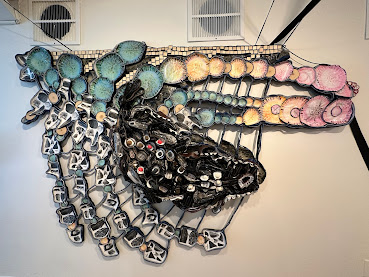
The Craft Contemporary Museum on Museum Row (Mid Wilshire) in Los Angeles just closed its fascinating exhibit: Strings of Desire. As an embroiderer myself I was fascinated by the work of these 13 artists.
The mixed media embroiderers followed the theme: outsider culture, to examine their status as non-Western, queer and/or artists who pursue fantasy in their work.
What struck me, (words from the Press Release) was "the slowness and intimate nature of the act of embroidery can capture . . . [the} state of desire before it reaches fulfillment." This is something I experience viscerally every time I stitch.
The Press Release also mentions that the work in the exhibit is "complicating and maintaining the legacy of embroidery." This is exactly my purpose in the hand stitching I do along with the use of additional media. I found this a powerful and important show and was glad I got to see it close up!
Saturday, April 29, 2023
Congratulations to Mary Tyler and Barbara Schnieder
Congratulations to Art Cloth Network members Mary Tyler and Barbara Schneider, whose work will be included in the Interpretations 2023 exhibition at Visions Museum of Textile Art in San Diego. The show opens on October 13.
Tuesday, April 25, 2023
Saturday, April 22, 2023
ACN meeting in Philadelphia - by Regina Marzlin
This weekend, ACN is meeting in Philadelphia for our annual in-person gathering. We are sharing our art through presentations, we visit local landmarks and museums, and go for delicious dinners. Here are a few impressions!
Joan, Judy and Melitta in Rittenhouse Square Park. The weather is beautiful!Wednesday, April 12, 2023
Life in the Anthropocene by Sue Sherman
Next I went into my database of photographs from my travels to find wild animals that would work on the quilt. It was helpful that the background shapes have some “floor” surfaces above and some below the horizon, so I could place the various animals on the shapes according to the viewpoint from which they were photographed. I created a line drawing of each animal on tracing paper, and stuck them on the background using repositionable tape. I had to dig deep for the photographs as it needed quite a lot of different animals to fill the space. Some of the images weren’t very good, but it turned out they were good enough to use at this small scale.
Next I used coloured pencils to transfer the entire image onto white cotton treated with soda ash, and brought the images to life using paint brushes to apply Procion MX dyes thickened with sodium alginate. The thing with dye is that once it is applied it is really difficult/impossible to remove, and there is no painting one thing “in front of” another thing. You need to dye paint the thing in the front first and then carefully dye paint the thing behind it by filling in the negative space. For example, if you look at the ferns next to the zebras, the ferns were created first and then I applied the orange of the planter all around the fronds using a very fine brush.
Once all the animals were created using the thickened dye, I
filled in the geometric shapes behind them, and then the sky-coloured
background.
Quilting this piece was fun!
My quilting and thread painting are one –the thread you see in the front
goes through all layers to the back, which means that I need to pay a lot of
attention to keeping the layers nice and flat.
I start in the middle and work out, and change thread frequently in an
effort to keep the quilted area fairly round.
Each animal has its own approach to thread painting, to try to get the
fur, feathers or scales as realistic as possible. The larger animals were done
using trilobal polyester, but for the smaller ones I needed to use 100wt. silk
to get the required definition. This was
also true for the giraffe, so that I could make realistic thread-painted fur on
its individual spots.
I would like to draw your attention to the beautiful rhino at the very front. His name is Baraka and he lives in the Ol Pejeta Conservancy in Kenya. Baraka lost one eye in a fight and lost sight in the other one due to a cataract. (With apologies to Baraka, I have flipped his image to fit the perspective -- it’s actually his other eye that’s missing!) It seemed somehow poetic to have a blind rhino at the precipice, symbolically leading the entire group into the unknown. Baraka is also a very hopeful image: he is especially vulnerable in a country where rhino poaching is a constant threat, yet he continues to thrive due to the care and support of humans who are trying to make a difference.
This piece has a lot of background, and I struggled to come up with something meaningful to put there. All-over wavy lines or swirls just wouldn’t be enough to complement the images in the foreground. It seemed that the unseen animals, the ones that have already gone extinct due to human activity, needed to be a part of the story. Not being able to take my own photographs of extinct animals, I could not create their ghostly images in thread, so I quilted their names all over the blue sky background in various sizes of cursive writing. Researching all these names was humbling and sad.
It was tough to come up with a name for this art quilt – Life in the Anthropocene seemed to nail down what I was trying to say, but I worried that people would need to look it up. On the other hand, this unfamiliar word is a great conversation starter, and looking it up may help viewers learn a little more about why scientists are saying we have moved away from the Holocene Epoch and into the Anthropocene.The finished piece is 63” high x 73” wide. If you missed it at the Branson Quilt Show
last month perhaps you can see it at the upcoming Paducah Quilt Show later this
month.
Saturday, April 1, 2023
Katazome and Ikat Exhibitions in the Greater Puget Sound Area
by Barbara Matthews
Katazome Today: Migrations of a Japanese Art
showing at the Whatcom County Lightcatcher Museum in Bellingham, WA now through
June 11, 2023
Ikat: A World of Compelling Cloth showing at the Seattle Art Museum now through May, 2023
![]() |
| Snowstorm by Cheryl Lawrence |
![]() |
| The Other Side of the Scarf, 2005, Mika Toba |
Ikat: A World of Compelling Cloth
At the entrance to the exhibit entitled Zurashi/Slipped you walk through 6,000 vertical lengths of indigo resist dyed warp that hangs from the ceiling to nearly the floor. Chinami and Roland Rickets who cultivate an indigo farm in Bloomington, Indiana created his exhibit, which took over a year’s time to produce.
![]() |
| Zurashi/Slipped by Chinami and Rowland Ricketts |
Ikat an Indonesian word translates as cord, thread, knot, or bundle. Ikat has three methods – 1) tying the warp yarn to introduce a resist, then dyeing of the warp, 2) the same tying for resist of the weft and 3) the method on both the warp and weft. Although the blurriness of the design is prized and quite beautiful, some of the pieces shown, for example the Japanese and Iranian examples shown here, had an exactness that could be achieved through a careful design and resist dyeing of both warp and weft.
![]() |
| Japanese Cloth double dyed warp and weft |
![]() |
| Cushion Cover and Prayer Cloth in collection of David and Marita Paly |
Typically silk and cotton fibers provided the warp and weft. Uzbek women produced their own silk raising silkworms and harvesting the silk from the cocoons that they use for both warp and weft. In the example shown here, a Munisak or robe, the silk warp is treated and woven with a cotton weft. Two hundred yards of silk were required to create the velvet effect.
![]() |
| Munisak (Woman's Robe) |
Saturday, March 25, 2023
Art/Ecology, an exhibit at the O'Hanlon Center for the Arts by Ileana Soto
Friday, March 17, 2023
Member Interviews: Connie Tiegel
We are thrilled to announce a new feature on our website: member interviews. Learn all about our members and their work through conversations exploring a variety of themes.
First up, is Connie Tiegel, installation artist, and one of the founding members of Art Cloth Network. Connie discusses her work, processes, and her studio workspace.