Saturday, June 29, 2024

The Mourning Project Arrives in Arch City by Mary Vaneecke

It was an incredible weekend in St. Louis as we created the first installation of TheMourningProject.com in the Midwest at The Gallery at the Kranzberg.  All 20,000 little elegies--pairs of handmade baby booties--are on display in the gallery to remember each child lost before their first birthday in the US.  We have the worst infant mortality rate in the developed world, and makers seek to honor loss families, raise awareness of the issue, and begin a conversation on how we can improve little lives.

The state of Missouri had the worst infant mortality rate in the country 10 years ago.   With the leadership of the Missouri Foundation for Health, and agencies like Generate Health and March of Dimes aiming for systemic change, the state now ranks 45th.  Progress is possible!

The installation will remain at The Gallery through August 8, when we will de-install to move the booties to the STRIDES event in St. Charles to benefit Infant Loss Resources on Saturday, August 10.    In July, we'll hold a panel discussion on how the community can support loss families at the Studio at the Kranzberg from 10-11 am on July 24.  


Installation view from the street

The Mourning Project, detail, altar

detail, the Missouri flag with the state's
portion of 20,000 baby booties

 
Viewers at the opening reception

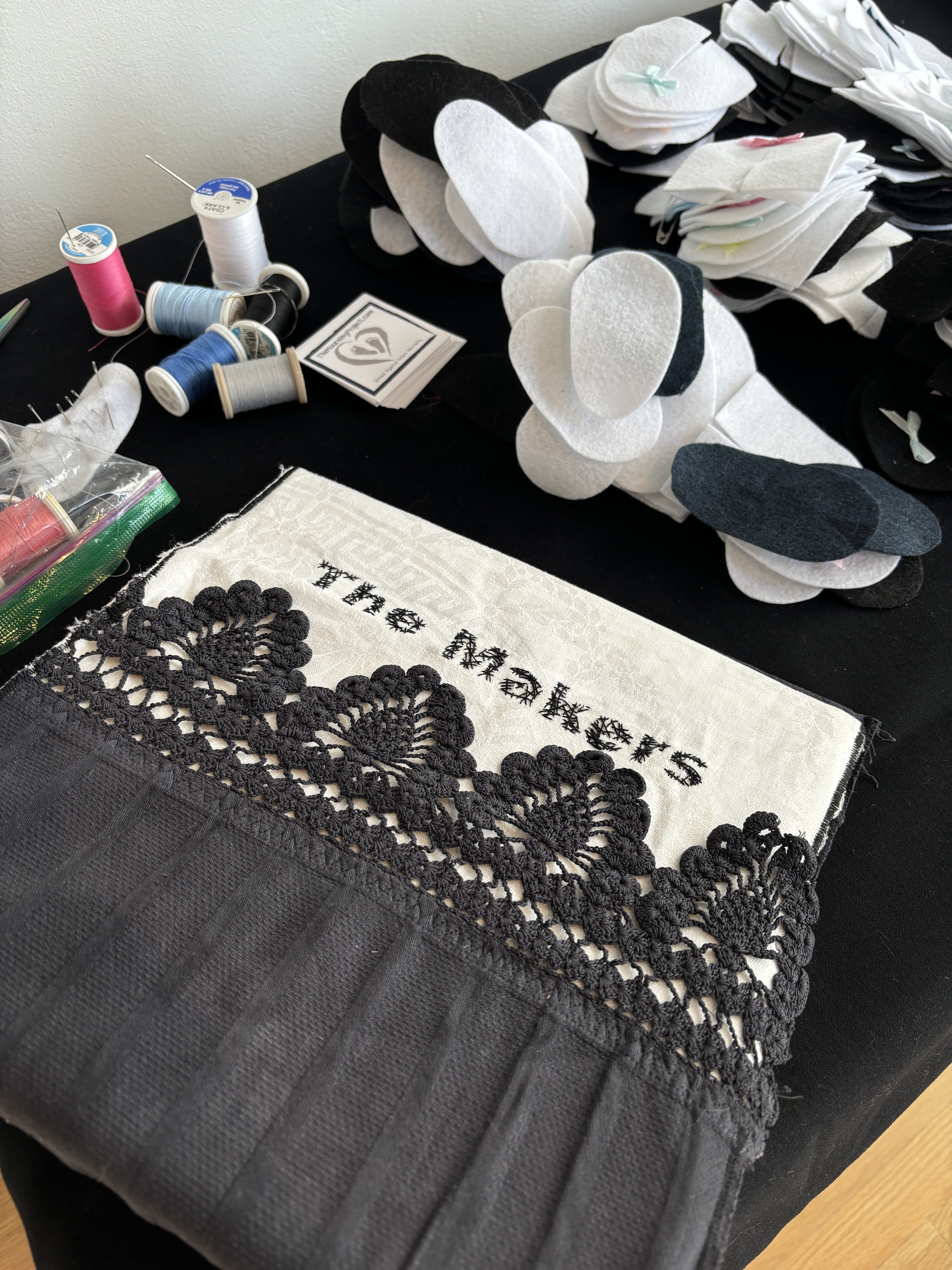
The Makers table

Carla and Gary Duncan with me at the installation

Carla Duncan helps installs the 'Mother Booties,' made in
memory of the 700+ American mothers who die from childbirth-related conditions.

the Mourning Project, detail

The butterflies await their release

Mary Vaneecke with Kendra Copanas of Generate Health and
Erin Coppenbarger of March of Dimes 


Installation view with the 'Thrive' Wall, which highlights the
work of some of the agencies combatting infant mortality across the state

A pair of booties made in honor of the thousands of infants
born into homelessness each year.  

The Mourning Project, detail

Art Cloth Network members created over 100 pairs to contribute to the project.  My thanks to all those who helped make this possible. 💜

For more information about the issue and the Project, go to www.MaryVaneecke.com


#20000BabyBooties     #UnitedAgainstInfantMortality    #BlanketChange


Tuesday, June 4, 2024

25 Million Stitches Exhibit - Barbara Schneider

 I recently went to see the exhibit - 25 Million Stitches at the Wisconsin Quilt and Fiber Art Museum in Cedarburg, WI. It was quite an experience.  This blurb gives the background information about the development of the exhibit.

This project provides a beautifully resonant expression of art/ activism that raises awareness of the immense number of peoples forcibly displaced from their homelands by violence and natural disasters. By choosing basic stitching as the means to tally the number of people displaced, those who are new to art-activism were drawn to it and became part of our collective mending, of repair. Every participant from 5 to 91 years of age, from the asylum seeker to the artist who had never thought of their art as an expression of social activism, became an essential part of project.

The full installation of these panels gives the viewer a way of processing the enormity of 25 million – the approximate number of refugees estimated by the United Nations High Commissioner for Refugees when this project started.  But the panels also have an important narrative quality, both individually and in their collective presentation.  Many panels convey images, symbols, and messages of solidarity, hope and community. The culmination of this community effort is a grand collection of diverse tapestries comprised of each participant’s unique expression of solidarity with the world’s refugees. We believe that the installation of this collection will raise awareness of the global refugee crisis and help people comprehend the enormity of it in a way that words alone cannot. 

The exhibit is shown in a very large old barn with tall ceilings and rafters. It allowed the panels to be hung in long rows of banners. They filled the space in rows with just enough space to walk between. They moved a bit with the movement of people and air. 

It was wonderful to be surrounded by this massive work. And deeply moving to see how different banners interpreted the theme. I have attached a number of photos of both the space and particular pieces. There is a short video with the curator, the developer and a viewer that gives a sense of being in the space as well as background on the Quilt Museum website. There is also a website for the 25 Million Stitches project. The exhibit is up till July 28.

https://www.25millionstitches.com/  

https://www.wiquiltmuseum.com/ 


Saturday, May 25, 2024

St. Louis or Bust! by Mary Vaneecke


I am so excited to be bringing TheMourningProject.com to the Gallery at the Kranzberg in St. Louis this summer!  This huge community art project of 20,000 pairs of handmade baby booties seeks raise awareness and improve health care for American infants.  The US loses 20,000 babies before their first birthday each year.  

The exhibition will run from June 22 (with the opening from 5:00-7:00 pm) through August 8.  Gallery hours are Saturdays from noon-4:00 pm and by appointment.  

I'll be highlighting local efforts to improve the lives of parents and babies in St. Louis.   

After the exhibition at the Gallery at the Kranzberg, I'll take the booties to St. Charles on August 10 for the 17th Annual Strides Steps of Remembrance event to support Infant Loss Resources.  

Hope to see you there.  


#artcloth

#ArtClothNetwork

#20000BabyBooties

#UnitedAgainstInfantMortality

#BlanketChange

Monday, May 13, 2024

Saturday, May 11, 2024

Artist talk with Elise Findlay in Canmore - by Regina Marzlin

  While we met in Canmore, Alberta, for our annual in-person meeting we had the opportunity to listen to an artist talk by emerging fibre artist Elise Lavallee Findlay. We convened at the Arts Place in Canmore where her exhibition "Another Life" was on display. Elise is located in Banff, Alberta, just a short drive away from our meeting location. She is a visual artist known for her versatile, process-driven practice. Her work is centering around the themes of community, place, identity, and the intricacies of human interaction with the world. 


The exhibition we saw was motivated by Elise's experience as a wood worker and cabinet maker. The series of pieces was started during the pandemic and Elise used some materials she had at hand during the lockdown. She pulled threads from drop cloth canvas material and stiffened it with cornstarch after shaping it around objects. The objects she depicts are woodworking tools that she used in her former job.

This is her artist statement about the series:

"This body of work began with an examination and a sculptural expression of my past experiences, and by extension, the challenges faced by women working in the construction trades. Through material and process I explored memories of my previous life, resulting in a series of fibre sculptures, which, while referencing woodworking tools, have become strange canvas shells. Each sculpture is a duplication that is and is not. The installation represents a place that no longer exits for me, yet it also is a starting point. Something here goes beyond the original idea and the process. It is a beginning, a way to explore transformation, and how, while I used to be a cabinetmaker, like the sculptures themselves, I am now something new."


Larger sheets were produced in the same way and then stitched into 3D models of woodworking tools like a band saw or a work bench. The pulled threads are part of the installation, they are scattered on the floor to resemble saw dust.


 I was impressed with the concept of using the humble material to convey her thoughts about a male dominated workplace. Deconstruction, reconstruction and transformation are key processes of Elise's art making. She also brought with her a body of work that is going to be shown at the Canadian War Museum in Ottawa, Ontario. The exhibition is "Outside the Lines - Women Artists and War" and her pieces were made in response to some of the artifacts shown in this exhibition. It was thought provoking to see a gas mask (see photo above) or shells made from the light and transparent fibre material. 

She also showed us a birch bark piece that was stitched.


Elise was a great and inspiring speaker and we had lots of questions for her. It was wonderful to connect with a fellow fibre artist. Please look up her website at elisefindlay.ca if you're interested to see more of her work.


Saturday, May 4, 2024

A Box of Good Fortune - Barbara Schneider

Last year I signed up for the Fiber Arts Take Two online course with Sally Tyrie called Visual Narratives. This was the second FATT course that I took. The course description reads:

Your training will begin with researching and examining areas of interest, before revealing ways of reimagining mark-making and collage from Sally’s considered and painterly approach. Use various print techniques without a press, including gelli plate, photo litho and collograph printing whilst learning to abstract visual narratives from any source of inspiration to create an ambitious body of work.

I was intrigued and looking, as always, for a way to expand my mark making.  She taught many different approaches and we were encouraged to make lots of samples.  I was familiar with some techniques, learned some new things, and discarded a lot of them as not being something I wanted to explore further. One of the best things about the course is that FATT provides and opportunity to submit a piece of work done during the class and then they create an online catalog (which you can also get in print through Blurb).

I had been working quite a bit on printing and copying (with my Epson printer) on pages from a vintage Japanese account book.  I built up layers of imagery on the page and pushed my printer to do things it was not meant to do.  I thought creating some small themed books (Japanese style) would be a way to create my catalog piece. But I felt like something was missing to bring the project together.


While out one day I saw an old box at a thrift store. It may have been an old painters box but any inserts were missing and it had no paint marks. I thought the box might make a great container for all of my book samples. Now all I had to do was clean it up, decide how to use the interior space, create it, finish the books, make a cover!  Step by step I worked my way through. It was really great to work on something totally different. I had done quite a bit of bookmaking and box making loooooong ago and this project brought me back to doing that kind of work again and how I like the precision of it and the play of images across pages.


I created a Kanji signature for my name to use on the back of the box.


This is the  statement that is inside of the box explaining the process, naming and techniques.

Daifuku-cho

A Box of Good Fortune


I was inspired to make this artwork by two disparate things- finding an old

artist’s box and a Japanese ledger titled Daifuku-cho (Good Fortune),

that I have long wanted to use in my work. Although a mundane object in Edo Japan,

the calligraphy and paper in the ledger are beautiful.  Ledgers were used to

record a merchant’s debts and payments. The box and ledger are the elements I

used to build a collection of samplers that explore the various techniques from

the Visual Narratives course.

 I used pages from the old ledger as the base to explore printing, overprinting,

painting and collaging with a variety of imagery. The samplers developed in

different directions under these themes.

Meditation

Contemplation

Introspection     

Rumination 
                        
The box was stained, and refitted with section dividers to hold the samplers.
 
I am now moving on to the other FATT workshop that I signed up for last year which is with Claire Benn using pigments and soy.  And then, someday, I will get to the 3rd one which is Sensing Place with Debbie Lyddon.  For these two I have watched all the video lessons and even if I never make a particular project I have learned something new, had time to think about it in relationship to my own work and know that I can go back to it at any time to review and try again. They fulfill my need to learn but at the same time to focus on my own work.  


Sunday, April 28, 2024

Looking Around

2024 is my year of exploring and learning. It’s also a time for revisiting some of my early ideas. One of the lessons in a basic photography class is to look up, look down, and look all around as you’re making photographs. This is one exercise used to develop an artist’s observational skills and I always loved it. I continue to look all around as I walk in nature, in the neighborhood, or around town with an intention to observe and be inspired by what’s around me. In the last few years I’ve been looking down a lot. I’m four months into my year and I’m embracing the joy and calm these “exercises in seeing” give me.

Example of some my iPhone photos of "Looking Down."

As I drove through my neighborhood, I was inspired by the gestural tar lines used to repair the asphalt, so one morning I got out of the car and started photographing the street—framing the lines to create lyrical, gestural compositions.

A few of my Tar Lines

Once these tar-gestures were printed on fabric I started having fun exploring how to enhance them by adding color, stitch and collage. Here are a few process photos and you’ll be seeing more of my progress in the next few months.

Tar Lines collage
 
Sampler testing out stitching on the tar lines,
including french knots, free-motion machine stitching,
hand stitching, and machine couching.

Wednesday, April 24, 2024

Art in Cuba by Connie Tiegel

 On a January 2024 trip to Cuba I met an artist named Yudit Vidal Faife. You are in for a treat when you checkout her website: www.yuditvidal.cult.cu 

Touring her house/studio in Trinidad, Cuba was a dip of the toe into the cultural waters of the embroidery tradition in Cuba.


In addition to making her own art she also teaches community classes to pass on the embroidery tradition to younger women.

In a country as poor as Cuba she has a great need for donated supplies of fabric, thread and needles.

Please contact Yudit Vidal Fiefe at: vidal.yudit@gmail.com if you would like to contribute supplies to her community projects.

by Connie Tiegel