

This is another from my Held Harmless series which calls out those who made the Pandemic worse but will never be held responsible for their bad behavior. Sadly, the series continues . . .
I made a paper collage, photographed and Photoshopped it then sent it off to Spoonflower to be printed. Once back I began the several weeks long hand stitching to bring out the design and add depth and interest.


During 2020 I spent much time scouring my accumulated fabrics from the past and creating new work from old. Made from previously painted, printed, and dyed fabric scraps, beads, found paper, hand stitching. 10"L x 5.5" W x 4.5" D.
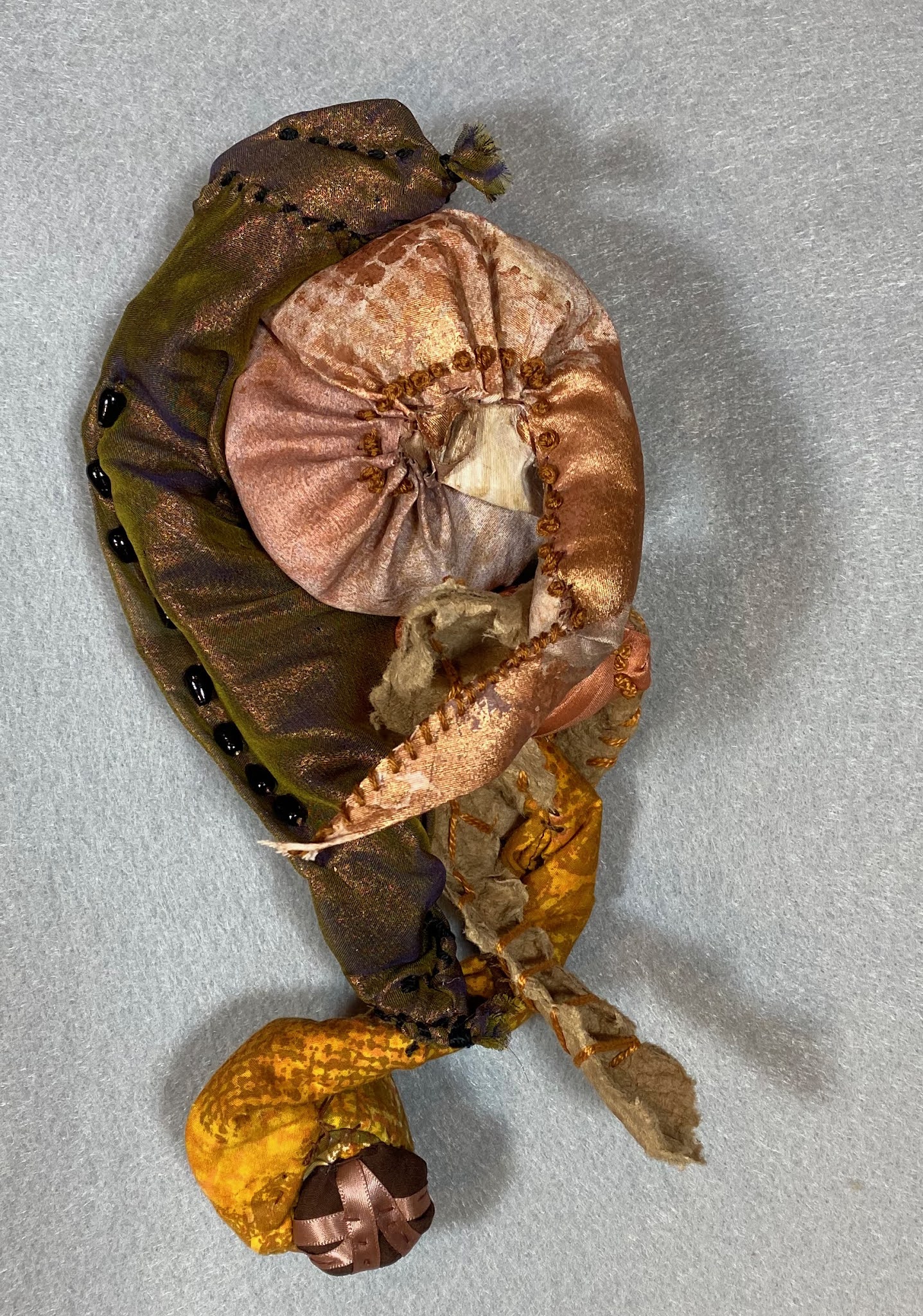 |
| Soft Sculpture III by Adria Sherman |
 |
| Cortical Columns, (28'' x 30'') by Regina Marzlin |
 |
| detail, Cortical Columns |
On recent hikes I have daydreamed about my hand dyed fabrics being part of the scenery. My hiking philosophy is “Leave No Trace” and “look up, look down, look all around.'' I like to absorb details.
On hikes I bring along my camera and my hand dyed silk and cotton scarves.
I take many photos of rock and cloth together.
Back home I manipulate the photos and use Shutterfly to make a book of our favorite ones. Carrizo Canyon 2020 was a gift to my husband for Christmas. And I've made 2 more books as well: Indio Hills Badlands 2020 and Henderson Trail February 2021.
 |
| Seated Rusty Spiral by Connie Tiegel |
 |
| Scarves on a Rock by Connie Tiegel |
 |
| Scarf Imitating Rock, by Connie Tiegel |
 |
| Scarf on a Rock by Connie Tiegel |
 |
| Border Wall Down, detail |
 |
| Border Wall Down, installation view |
 |
| Border Wall Down, detail |
The Blue Door Art Center in Yonkers, NY is hosting their exhibition Falling into Layers: Contemporary Art Quilts from October 7-30. The show will feature work by Art Cloth Network members Barbara Schulman and Mary Vaneecke. Two works from Mary's Samaras series are included. An image of bladderwort plants and maple seeds scattered on water inspired the series. Mary is interested in how humans deal with chaos, find beauty there, and relinquish control in the face of it. See more of the series at www.maryvaneecke.com  |
| Off the Wall II (94'' by 24'') by Mary Vaneecke |
 |
| Samaras Really Do Grow on Trees (36'' by 36") by Mary Vaneecke |
My first large-scale Bojagi work, Communion, was an outdoor installation piece created for the Suwon Hwaseong International Theatre and Arts Festival in Suwon, South Korea, a UNESCO World Heritage site.
I called the work Communion as I felt I was joining Korean culture with my own. As it united physically, it united spiritually. As a Cuban-American exhibiting work in Korea, I felt suddenly that the world was much closer to me.
 |
| Communion, partial view |

Yolanda Sánchez, Communion, 2011, installation at the Suwon Hwaseong International Theatre and Arts Festival in Suwon, South Korea
Sherri Lipman McCauley writing about EIGHT: In Depth, An Invitational Exhibition -


Thrilled to say that I
have been invited to show my work with a group of local women artists, “EIGHT: In Depth”, at the Round
Rock campus of Texas State University (Avery Building Gallery), 1555 University
Blvd., Round Rock, Texas. The exhibition will be on display until October 29.
Covid permitting, there will be a reception the evening of Friday, September
10. Please come by if you are in the neighborhood!
How has your creativity evolved over the years? What triggered the evolution to new media/kinds of work/ways of working?
I was fortunate to graduate from the University of Washington Fiber Certificate program, which launched my art career. In the beginning, I had dabbled in weaving, knitting, quilting, and silk painting and I extended these methods to my art. I loved the radiance of dyed silk. I took a class with Karen Sistek, a Master Silk Painter, who adhered her paintings to canvas. I tried the same method on acrylic glass and found the silk seemed to become one with the acrylic. This allowed me to stand my pieces upright so that light could shine through.
Discovering this opened-up avenues
into laser cutting and woodworking. I
use the laser cutter to cut shapes from the acrylic glass, then I adhere the
dyed silk to these shapes. The process
is enjoyable from beginning to end, starting with drawing templates by hand to
tracing the images within a software program to the final trimming of the silk on
the acrylic form.
Because I needed a base for my
pieces to stand upright, I took classes in woodworking and ultimately became
hooked on wood. I love the juxtaposition of soft with rigid--silk with acrylic
glass, fiber with wood. The contrast
emphasizes the beauty of both.
Which artists do you admire? What draws you to their work?
Fine craftsmen inspire me,
especially those who work with wood, but also paper, textiles, glass, and metal. The ability to transform a material to a
shape and form of art requires not only years of experience, but a deep
appreciation and understanding of the material, plus a profound desire for
perfection.
Are there recurring themes in your work?
I am intrigued by those things that are larger than life, like trees. These regal beings have a knowing grace that seems to surpass our limited knowledge of the world. Their lives span many of our generations, but their strength and sturdiness remain vulnerable to the finality of an axe. This contrast between strength and fragility is interesting and perhaps represents our own vulnerability. I am shown here in front of a 2,000 year old Redwood in Stout Grove Reserve in the Redwood National Park.


Likewise glaciers have an exquisite beauty that is only deepened by our knowledge of their age in millennia. Still these massive structures suffer a demise at the hand of man. The pieces here are ‘Glacier Cathedral’ and ‘Ice Star’.


Perhaps because I am an introvert myself, I recognize the vulnerabilities within people as well. Am I the only one who sometimes does not feel comfortable in her own skin? It was that idea that lead me to create ‘Aliens Among Us’.


Do you think that creativity comes naturally to people, or do you think creativity is a skill that people can learn?
Everyone
has the capability to be creative. Gardeners,
woodworkers, cooks, even housecleaners create as a result of their interest or
profession. I would argue that creating
is a state of mind. It has to do with
taking ownership and pride in your work.
I have frequently thrown together a dinner that was food and not at all creative. Likewise, I have taken the time to create a
lovely meal. I made masks for the
pandemic that were strictly utilitarian, others took the time and dedication to
create well-made and practical masks. I
could even suggest that we could look at our interactions with our children and
friends as creating. We are creating
adults of the future and relationships that are lasting and meaningful. If we thought of the creation aspect, would
that not elevate the importance of our conversation with more pleasing
outcome?
When it comes to creating, are you more of a planner or an improviser?
Creativity
for me has been a challenge. Because of
my years as a researcher in my prior profession, I have the experience and proclivity
to plan. A well-designed process has
always worked for me and I love that part of my art—graphing designs, measuring
angles, engineering pieces. I also work
from a concept, so have the additional challenge of representing that concept
without being literal. Because of these tendencies, I have found my pieces sometimes
are unexciting and lack magic.
To
counter this, I have purposefully started to improvise pieces, so folding and
cutting paper to create structures without first graphing the size and shape. Plus, I have introduced play into my process
by doing collages and mark-making without any intention of ending with an art
piece.
What do you do differently? What is your signature that makes your work stand out as yours?
One
thing I do is mix my own dye colors. I
love the science of colors (of course) and so only have magenta, cyan, yellow,
black dyes, and my own dye mixtures in my cabinet. I even mix my own black starting with a
commercial black, because it is not the black I seek.
I
am not aware of others who are applying dyed silk to acrylic glass in art
pieces. Some have applied silk to glass
bowls for a very lovely effect.
Do you use a sketchbook or journal? How does that help your work
develop?
I use a sketchbook for ideas and a
journal to document my process. I
frequently go back to prior dye recipes and these are thankfully documented. Recently the wood on a piece I had sold years
before was warping. I was able resolve and correct the issue by identifying the
wood and gluing process I used.
Tell us about a challenging piece. What were the obstacles and how
did you get past them?
When I started using acrylic glass,
I knew I needed a base for the pieces to stand upright. I consulted a carpenter friend, who made a
prototype. I then needed to have access
to a shop and learn how to use the equipment.
I took a woodshop class, made a coffee table, and learned how to use a
table saw, chop saw, band saw, jointer, planer, belt and disk sanders, and router.
My design for a base has evolved, my last was version three and there will be a
version four.
Do you
focus on one piece exclusively from start to finish or work actively on more
than one project at a time?
I work on pieces for specific calls
for art and so these deadlines drive my process. I am usually working on several pieces at a time.
Original article published in CreateWhimsy.com
Photography of Glacier Cathedral, Ice Star, Perfectly Imperfect by Michael Stadler Photography
